
- 名古屋文化のみち二葉館,由名伶川上貞奴所打造的大正浪漫宅邸 - 2026-03-30
- 一桌陌生人一起吃辦桌:千歲宴菜色與北部辦桌文化觀察 - 2026-03-26
- 愛知縣福よせ雛計畫:雛人形再就業,用幽默重寫傳統 - 2026-03-23
澄
如果你需要中文版,可以在這裡找到,歡迎點擊閱讀。
I had always wanted to experience wearing a junihitoe. That wish grew so strong that I even organized a small lecture about it and later turned the lecture content into a written article in Chinese. Unfortunately, because of budget limitations, I never had the chance to actually try it, and that became a lingering regret.
I kept telling myself that I would experience it someday, but whenever I traveled abroad, there were always so many places I wanted to visit. Sometimes the issue wasn’t only money but also time, and I simply couldn’t fit a junihitoe session into the schedule.
So I decided to organize all the information I had collected about junihitoe studios. That way, when I finally have both the budget and the time, I won’t have to search again—I can just add it straight into my itinerary.
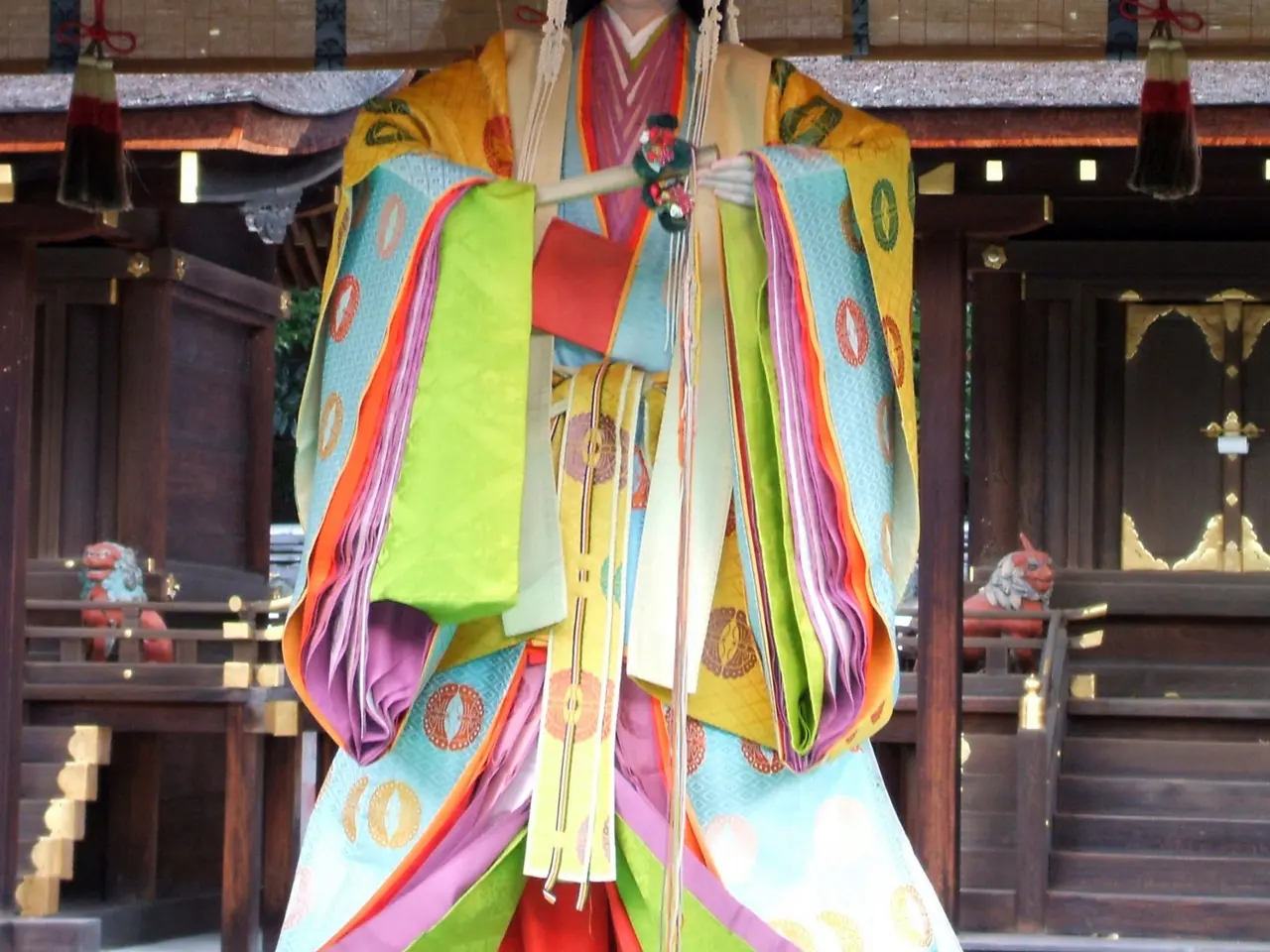
Before going further, here is a brief explanation of the term junihitoe.In this article, junihitoe refers to the full formal ensemble known as Itsutsuginu–Mo–Karaginu (五衣・唐衣・裳). For simplicity, and because it is the common usage in Taiwan, I will refer to all of them simply as junihitoe.
The junihitoe is the highest formal court attire worn by imperial women today. Aside from it, there are also indoor court robes such as the kouchigi and hosonaga, and outdoor formal attire such as tsubokazari shōzoku and utakamuri–kariginu. All of these are official court garments, differing in function, formality, and historical period, which also means the experience fees vary widely.
As a general rule, the more elaborate the set, the more expensive it becomes and the junihitoe, with its many layers and the most ornate materials, is naturally the priciest option.
For readers who may not be familiar with the junihitoe, I wanted to briefly introduce how the standard Emondō dressing procedure works, and what proper assistance from a dresser should look like. I therefore found an excellent instructional video supervised by Sengoku Munekazu, head of the Takakura-ryū, one of the official dressing schools.
To give a bit of background: Takakura-ryū is the school appointed by the Imperial Household since the Meiji period to preserve and promote traditional court attire such as the junihitoe. It remains the main school serving the imperial family today. A friend of mine actually studied at a Takakura-ryū junihitoe class, and her Yūsoku Kojitsu certification carries Sengoku Munekazu’s signature.
The video demonstration of modern imperial court attire is rare and incredibly valuable—and it includes both men’s and women’s dressing procedures. Since most readers are likely more interested in the women’s junihitoe, I will skip the men’s section here and start directly with the women’s demonstration. Those who want to see the men’s part can simply scroll back.
Key Notes — The Importance of Indoor Backdrops
Because official court garments are extremely expensive to produce, a full junihitoe set usually starts at over one million yen. For this reason, most studios do not allow customers to go outdoors for photos. The risk of damage is simply too high, especially for outfits that require wearing long hakama. Whether it is the junihitoe, hosonaga, or kouchigi, all of these garments require you to walk while lifting or kicking the fabric. Going outside would require additional attendants to help manage the outfit, so it is best to be prepared for an indoor-only experience.
When choosing a studio, it is important to look carefully at the photos of the indoor shooting space. In most cases, that will be the only background in your final pictures. It is a good idea to search for sample photos from past customers and check the atmosphere and quality of the setting before deciding which studio you want to visit.
Junihitoe Experience Studio Guide
When introducing each studio, the main focus will be on the junihitoe experience. For this reason, the price list includes only the junihitoe plan. Listing every single plan offered by each studio would make the table too long and cluttered. The basic information section already includes links to each studio’s website or social media, so you can click through for the full details.

After An Illustrated Guide to Japanese Court Robes, p.116
Except for the last studio, the first four all have professional backgrounds. The head instructor of Yayuki is from the Takakura-ryu school. The Nishijin Textile Center, Kuroda Costume, and Yaei have all supported major traditional events in Kyoto. Their technique and dressing procedures are reliable, so the next point to consider is the visual result after dressing. I therefore tried to find videos that show how the junihitoe looks when worn.
Since the junihitoe experience is relatively expensive, reviews and user videos are much fewer compared to regular kimono rentals. When selecting videos, I prioritized customer-made videos, followed by studio-made videos, and then any footage showing their dressing process. At the end of each studio section, I will also include links to photo or blog posts whenever available, so you can have as much information as possible when deciding which studio to visit.
Miyabi Yuki
Yayuki is the experience studio operated by the kimono school I attend in Kyoto. My introduction of them is not meant as promotion, nor do they need it. The reason I list them first is simply because the connection is quite special.
When I first visited Kyoto years ago, I had planned to try their tsubokazari shozoku experience. But my budget at the time was too limited, and I had also wanted to try a kimono rental and a maiko makeover. Doing all three was impossible, so I removed the tsubokazari plan from my list.
I eventually forgot about it. Years later, when I was preparing to take an exam in Kyoto and my teacher introduced the Kyoto school, I saw the logo and immediately felt it looked familiar. Then I saw the photo of the tsubokazari shozoku, and everything came back to me. I had never imagined that after so many years, the experience I could not afford back then would greet me again only after I became a student. The connection felt truly remarkable.
Their outfit combinations are not fully displayed on the website. Only the main categories are listed, but if you follow their social media, you will see many different coordinated sets. They probably do not photograph everything simply because there are too many. Behind the decorative wall hangings are rows of storage boxes. I have seen my teacher reach in and effortlessly pull out kimono and obi that were unbelievably beautiful. It really feels like the space behind the wall is Doraemon’s pocket.
As for the dressing and photography environment, the machiya space is surprisingly spacious. Even four or five people experiencing together will not feel crowded. In terms of atmosphere, it is one of the two studios among the four that most closely resembles the Heian court setting. Besides the kichō curtains, they also have misu screens, decorative wall hangings, and other court-style furnishings. Back when I was still attending class, I did not fully understand why the room was arranged that way; I only felt it had a classical charm. It was only after returning to Taiwan and following the school’s Facebook page that I realized why. The classroom itself is also a photography space.
If you want a stronger Heian-period atmosphere, you can add an optional experience with court games such as tōsen or kai-awase. They work well as props and make the photos feel more historically immersive. These activities are more fun with at least two people so the photos look richer, since playing alone can feel a little lonely. For groups of friends or coworkers wanting to experience it together, Yayuki is the studio I would recommend first. Since it is originally a school specializing in kimono and junihitoe, they have a large number of garments, more variety, and enough staff to support group sessions. Everyone can finish dressing around the same time without long waits.
Miyabi Yuki
Price: Junihitoe 35,000 yen
Eligible Participants: Men, women, and children
Outdoor Plans: Tsubokazari shozoku, uchigi–hakama, and kariginu available for outdoor strolls
Address: 807 Tsukinukecho, Kamaza-dori Sanjo-agaru, Nakagyo-ku, Kyoto
Phone: 0120-877-990
Hours: 09:00–18:00
Notes: Group experiences available; English support provided
Website:miyabi-yuki.jp
Social Media:Facebook、Instagram
Other Experience Reviews
Nishijin Textile Center
The experience at the Nishijin Textile Center is very straightforward, with only one plan for men and one plan for women. It may be difficult for multiple people to participate at the same time, and there are no optional add-ons. From the reviews I have read, the outfits appear to be the same set for every participant, so there is not much to choose from. If you do not like the color combination shown in their sample photos, you can simply skip this studio.
One special point is the hairstyle. Nishijin Textile Center provides a wig styled in the manner of the Saiōdai, which is something other studios usually charge extra for. Here it is included in the base fee. On both sides of the flat hair ornament, they add the white braided decoration known as hikage-no-ito, or shadow threads. With the addition of the hikage-no-ito, the traditional straight black hair gains a softer and more graceful look. This style is specific to the Saiōdai. For the hair ornament alone, I feel that experiencing the junihitoe here is quite appealing.
The background for the photos is simple and has an old-fashioned studio feel, like a traditional portrait taken at a photography shop. Whether you like this style depends on personal preference. The golden folding screen used in the background is also something other studios usually charge extra for. In short, Nishijin Textile Center is suitable for those who want a straightforward junihitoe experience, especially if the main goal is to feel what it is like to wear a set that weighs more than ten kilograms and to experience the surprising lightness when the garments are removed. For that purpose, this studio is a good choice.
For me, the biggest attraction is that the Saiōdai-style hikage-no-ito hair ornament is included at no extra cost. This is not a standard option at most studios. Only at the Nishijin Textile Center is it offered as part of their regular experience, which is very tempting. As for the outfit and the background, those are details that can be taken less seriously in this case.
Nishijin Textile Center
Eligible Participants: Men and women
Outdoor Stroll: Not available
Address: 414 Tatemonzencho, Kamigyo-ku, Kyoto
Phone:075-451-9231
Hours:9:00-17:00
Website:nishijin.or.jp
Social Media::Facebook、Instagram
Other Experience Reviews
- Junihitoe Experience in Kyoto
- A Journey of a Thousand Miles: Day 10 – Junihitoe Experience at the Nishijin Textile Center
Kuroda Shozokuten
This studio is quite unique because it is operated by a manufacturer that actually produces court garments. They create yusoku-patterned clothing, which means they make real junihitoe sets, men’s formal belts, and other traditional items. As a result, you can not only experience the junihitoe here but also purchase small accessories featuring yusoku motifs as souvenirs. The shop itself is an old establishment in Kyoto, founded in the early Edo period and now run by the nineteenth-generation head. Because of their long history and expertise, they also support the Aoi Festival, one of Kyoto’s three major festivals. The sense of history and authority is unmistakable.
Since their main business is garment production rather than experience services, their reservation form lists only four options: three for women, which are the junihitoe, the noshi, and the kouchigi, and one for men, which is the formal belt attire. If you want to try other types of garments, I found a Japanese blog where the writer wore an outfit not included on the list, so it may be possible. In that case, you would need to email the studio to discuss the request. For hairstyles, there is only one option, which is the traditional straight hair style. White makeup is not offered.
Because they produce these garments themselves, the dressing environment includes items such as kichō curtains, misu screens, and decorative wall hangings. The overall atmosphere is excellent. Their golden folding screen, decorated with motifs such as pine, bamboo, plum, and cranes, creates both elegance and presence. It feels like an upgraded version of the junihitoe experience at the Nishijin Textile Center. If you find the Nishijin Textile Center’s experience too simple and prefer not to deal with too many choices, then Kuroda Shozokuten is an easy and reliable option.
I also found a feature video about the shop, filmed by Kyoto Shinchi. The content is extremely informative, especially the moment around 2:41 where the current head crafts the hand-rolled edge of a junihitoe robe. When I attended a lecture before, the instructor explained that this rolled edge is an important reference point for the dresser during the dressing process. Back then, I only saw still images. I never expected to see the actual movement, which felt like a surprise reward while writing this article.
Kuroda Shozokuten
Eligible Participants: Men and women
Outdoor Stroll: Not listed on the reservation form, but some Japanese bloggers have shared experiences of tsubozōsoku and kariginu outdoor strolls. Please inquire by email.
Address: 63 Kagiya-chō, Marutamachi-dōri Sakai-machi Higashi-iru, Nakagyō-ku, Kyoto,
Phone:075-211-8008
Hours:10:00-15:00
Website:www.hei7.jp/kuroda-shozoku/
Other Experience Reviews
- First Visit to Kuroda Shōzoku-ten
- [Kyoto] Nyōbō Costume at Kuroda Shōzoku-ten (1) [Between the Rainy Days]
- A Story About How Beautiful the Junihitoe Is: Morning Show (2017/08/02)
Setsugekkaen / Iyasaka Co., Ltd. Heian Court Apparel Experience
It took me some time to confirm that these three names all refer to the same place. Setsugekkaen and Iyasaka each have their own website, but their social media accounts list both names side by side, so they are indeed the same business. Heian Court Costume Experience Studio appears to be their old name, as their Facebook page still uses it, but the page stopped updating in 2018. Since they moved once, from Nakagyo Ward to Fushimi Ward, it is likely that the renaming happened around the time of the relocation. This explains why many experience reviews online refer to these three different names, even though they all describe the same studio. When I was researching, I was also confused for a moment about why these three places looked so similar.
Among the four studios, Iyasaka is the farthest from central Kyoto, located in Fushimi Ward. Although it is still within Kyoto City, it is not the same as moving around within the city center. It is similar to how Tainan’s Shing-Ying District and the central West Central District feel completely different even though both are within Tainan City. If you plan to visit Iyasaka, it is best to combine the experience with one or two nearby attractions so the trip feels more fulfilling. Fushimi itself has many great places to visit, such as Jonangu Shrine, which hosts the Kyokusui-no-En ceremony twice a year, Fujinomori Shrine known for hydrangeas, the Gekkeikan Okura Sake Museum where you can taste sake, and the Jukkokubune boat ride for cherry-blossom viewing along the canal. All of these are worth adding to the itinerary.
The most distinctive feature of Iyasaka is their all-white junihitoe set. It is perfect for those who want to experience both the white wedding uchikake and the junihitoe at the same time. However, the charm of the junihitoe lies in its layered kasane color combinations at the neckline. While the all-white junihitoe is visually striking at first glance, I would suggest treating it more as a wedding reference option. For a cultural experience, choosing one of the other color styles will be more enjoyable.
Aside from the white set, Iyasaka has created full coordinated color combinations for all their junihitoe sets, and you can preview all of them on their website before your visit. If you want to check the detailed layer colors and the number of garments in each set, you will need to visit the Setsugekkaen website, which provides more complete information. The Iyasaka site is less detailed in comparison, though the all-white junihitoe is introduced only on the Iyasaka website.
Setsugekkaen / Iyasaka Co., Ltd. Heian Court Apparel Experience
Eligible Participants: Men, women, and children
Outdoor Stroll: Not available
Address: 2-chōme-123-3 Nishiura-chō, Fushimi-ku, Kyoto 612-0029
Phone:075-642-1028
Hours:09:30~12:00,13:30~16:30
Email:[email protected]
Social Media:instagram
Other Experience Reviews
Jidaiya Arashiyama
I hesitated for quite a while about whether to include Jidaiya Arashiyama in this list. Compared with the four studios mentioned earlier, their junihitoe dressing process is not based on formal Emondō techniques, like the demonstration shown in the introductory video. They also do not have the same professional background as the other four studios, and in some of their videos, certain movements appear less refined. Once you have watched several proper junihitoe dressing procedures, the subtle differences become quite noticeable.
I ultimately decided to include this studio because their photography results are quite refined, the white makeup is beautifully done, and the straight hairstyle is styled in a way that does not look old-fashioned. Another point is the demonstration video below. Although it is not the formal Emondō dressing method, the garments are still wrapped on layer by layer, which shows an attempt to follow traditional practice as much as possible. Between the ideal and what is realistic in a commercial setting, you can sense the effort the staff are making.
Having worked at a yukata rental shop before, I know firsthand how difficult it is to balance traditional standards with staffing and business operations. It was one of the main reasons I often disagreed with my supervisor. Because I understand how challenging the reality can be, and because some people care more about the final visual outcome than the authenticity of the dressing procedure, I decided it was still worth including this studio in the guide.
Another notable point about Jidaiya Arashiyama is the sheer variety of historical costumes they offer. You can try outfits from many eras, such as Sengoku-period princess styles and kosode with koshimaki, Edo-period Ōoku noblewomen and nuns, oiran courtesans, and even Western-style Rococo-influenced dresses from the Rokumeikan era after the Meiji Restoration. They also release limited-time costumes from time to time. Some of these outfits are surprisingly well researched. I actually discovered this studio through one of their research articles, and later, in their videos, I even saw the large court hakama worn by female attendants in the Edo palace. It is not a common costume offered for experiences, yet they recreated it. I have to say I was genuinely impressed.
Because they offer so many costume options, it is much easier to bring friends along. Not everyone is interested in the junihitoe, and having other choices makes it more appealing for friends to join the photoshoot. Since their costumes span multiple historical eras, you can also create fun and intentionally contrasting photos. When I noticed that they had Ōoku costumes, the first idea that came to mind was photographing Ōoku attire and the junihitoe together, which would resemble scenes from the late Edo period involving Atsuhime and Princess Kazu. Pairing the junihitoe with a Rokumeikan-style Western dress would evoke the early Meiji era, when the aristocracy adopted two different forms of formal attire. Producing photos like these seems incredibly fun.
The studio background, however, is quite simple, which is one of its main shortcomings. Unlike the other four studios, which incorporate at least some elements of a court setting, this one lacks that atmosphere. They do have props such as kichō curtains, but the overall feeling is still not quite there, which is a bit unfortunate.
I later came across one of their experience videos by chance, so I have included it below as additional reference.
Jidaiya Arashiyama
Eligible Participants: Men, women, and children
Outdoor Stroll: Tsubozōsoku, Abe Seimei (karifuku)
Address: 4-10 Sagatenryuji Tateishicho, Ukyo-ku, Kyoto 616-8375
Phone:075-201-7832
Hours:09:00~17:00
Email:[email protected]
Website:jidaiya-kyoto.com
Social Media:instagram、Facebook
Free Kouchigi Experience – Currently Suspended Due to the Pandemic, But Recorded Here for Reference
This section introduces places that offered free experiences before the pandemic. The outfit provided was not the full junihitoe but a simpler kouchigi set. Even so, with the Heian-style court backdrop used for the photos, the results still captured the atmosphere very well. It was a good option for anyone traveling on a limited budget.

After An Illustrated Guide to Japanese Court Robes, p.32
Costume Museum
The Costume Museum recreates scenes of Heian-period court life based on careful historical research. Everything, from the dolls and clothing to the architecture and furnishings, is crafted with remarkable detail. It feels completely different from viewing real artifacts, and the museum even changes parts of the display according to seasonal festivals. Visiting at different times of the year gives you different exhibition settings, creating the curious feeling of celebrating the same festivals as the nobles of the Heian court.
In addition to helping visitors understand aristocratic life of the period, another reason I recommend the museum is that you can observe the postures of the dolls. These poses are very useful as references for photos later. Modern photo poses do not match the elegance of classical court attire, and it is difficult to express the beauty of the junihitoe without understanding the traditional posture and mannerisms. If you want to make the most out of your photo session, this museum is well worth a visit.
Although the website does not mention offering kouchigi for visitors to try on, many blog posts and visit reports include photos of such experiences. Because of this, I wanted to visit during my first trip to Kyoto. Unfortunately, the museum was under renovation at the time.
The gap between trips was so long that I completely forgot to go again on my second visit. On my third trip, the museum was very close to Kunjudo, and I even thought it would be the perfect and convenient combination. But since it was slightly off from the main sightseeing route on my map, I ended up forgetting once again. Kunjudo became the one fragrance shop I regretted missing, and the Costume Museum became another place I still have yet to visit.
In 2024, I finally fulfilled my long-held wish to visit the Costume Museum. Unfortunately, the kouchigi experience was no longer available on site, which was a bit disappointing. Even so, the dolls and the recreated scenes inside the exhibition hall were exceptionally well made, especially the beautifully crafted Rokujō-in set inspired by The Tale of Genji. It is absolutely worth a visit even without the free dressing experience.
However, the museum building is currently undergoing seismic reinforcement work, and the museum has temporarily closed. It is scheduled to reopen in 2028, so anyone planning to visit will have to wait a little longer.
Costume Museum
Address: 5th Floor, Izutsu Samegai Building, Horikawa-dōri Shin Hanayachō Sagaru, Shimogyō-ku, Kyoto 600-8468
Phone:075-342-5345
Hours:10:00-17:00
Email::[email protected]
Website:www.iz2.or.jp
Other Visitor Articles
Kyoto City Heian Kyō Sōsei-kan
After seeing the court-style settings inside the Costume Museum, the next place to visit for a sense of the Heian capital is the Kyoto City Heian-kyō Sōsei-kan. The museum features a large reconstruction model of Heian-kyō, created to commemorate the twelve-hundredth anniversary of the city’s founding. Even though the model is built at a 1/1000 scale, it is still remarkably impressive.
Another highlight is the “Heian-kyō Overlay Map,” developed in collaboration with Ritsumeikan University. This system overlays the ancient map of Heian-kyō onto Google Maps, allowing visitors to walk through modern Kyoto while imagining what the city looked like in the Heian period. With the help of linked information, you can better understand the historical layers beneath your feet. It feels somewhat similar to the “Tainan Historical Maps” app.
In addition to the reconstruction model, the museum also displays a ceramic mural of the Rakuchū Rakugai Zu Byōbu (Uesugi version), a detailed model of the Chōdōin’s main hall, which was used in the Heian period to receive foreign envoys and conduct state ceremonies, as well as a partial reproduction of the Genji Monogatari Kuruma Arasoi Zu folding screen. These are only part of their permanent exhibition. Their special exhibitions are also excellent. Past themes such as “The Lost Palace: The Ise Saiō and Heian-kyō” and “The Pleasures of the Heian People: Games and Competitions” are exactly the kinds of topics that interest me.
Another surprising point is that the museum offers free dressing experiences with the kouchigi and kariginu. The setting includes Heian-style props such as kichō curtains and misu screens, creating a very authentic atmosphere. It is incredibly generous for a museum to offer this at no cost.
Since this is not a place most Taiwanese travelers naturally include in their itinerary, and even fewer people are aware of the dressing experiences, it is no wonder that Chinese-language information about it is scarce. If I were not writing this article, I would never have discovered that this museum offers such a unique opportunity.
Kyoto City Heian Kyō Sōsei-kan
Address: 9-2 Jurakumawari Matsushita-chō, Marutamachi-dōri Shichihonmatsu Nishi-iru, Nakagyō-ku, Kyoto 604-8401
Phone:075-812-7222
Hours: 10:00–17:00, closed Tuesdays
Website::heiankyosouseikan.asny.ne.jp
Other Visitor Articles
- Mirror Tales of Kyoto 2017: Creation and Leisure
- Exploring the Ancient Capital with the Heian-kyō Overlay Map
Conclusion – And the Place I’d Choose Is…
After finishing this entire article, the place I most want to visit is Gosho Yashiro-no-Mori in Tokushima. It is a unique location that combines a Shinto shrine, a lodging facility, and a Heian-period costume experience studio all in one.
The main reason I want to visit this place is that I have already been to Kyoto three times, and I feel like it is time to explore a different region. The first time I chose Kyoto, it was because I thought it might be my only chance to go. Later, whenever colleagues invited me on trips, Kyoto somehow became the default destination. After that, my next visit was for classes and exams, and I expect that any future trip to Kyoto will also be for study or training.
Since a trip to Japan is precious and the country is so vast, I want to experience a different side of its local culture and atmosphere. Even though I have not fully explored Kyoto, I still want to see a different region and enjoy a version of Japan that feels unlike Kyoto.
When I discovered Gosho Yashiro-no-Mori, it immediately caught my attention. The entire complex is built with the Heian period as its architectural concept. With such a setting, you could easily take beautiful photos even without Heian-era costumes—wearing a kimono alone would already drain your camera battery. And they even offer Heian costume experiences. Wearing a full junihitoe there might be a bit intense, but it doesn’t matter; choosing a kouchigi or tsuboshozoku would already be wonderful. The facility also provides an impressive range of props, and they even have a kichō-dai platform. With that, you can take plenty of photos without ever stepping outside the building.
If you wear something lighter like the tsuboshozoku, you can also walk around the grounds. The property includes bamboo groves, small bridges, and flowing water features, giving you even more places to photograph. You could create amazing photos without ever leaving the accommodation. And if you stay overnight, it becomes even more convenient. After the tiring process of wearing traditional layered clothing for half a day, soaking in their hot spring would be the perfect way to recover. Ending the day by resting inside a room designed to resemble a Heian-style residence sounds like a truly special experience. This is why I felt so drawn to this place when I found it.
Although Gosho Yashiro-no-Mori is currently my top choice, I would still like to experience a formal junihitoe dressing in Kyoto at least once. During formal dressing, the garment-stabilizing cord wrapped around the waist must be tied firmly, yet without causing discomfort to the person of higher rank, and without shifting or disturbing the layers. It requires a gentle yet steady strength. This kind of experience is completely different from simply wanting beautiful photos. If I ever have the chance, I would still like to try it properly.
As for which place would be my first choice, among the five studios mentioned earlier, I would consider all of them except Jidai Ishō Henshin Studio for junihitoe. For that studio, I would prefer to try their non-junihitoe costumes, such as their Ōoku-style outfits or their limited seasonal programs like the mogu shōzoku or Kyōhō-bina styling. These are rare and sometimes exclusively offered there, so I would definitely be interested in going for those.
For the remaining four studios, it will really depend on timing and how the trip is planned. Whichever one fits best with the schedule and circumstances at the moment is the one I will go to. Plans often change unexpectedly anyway. Still, the likelihood of choosing Yayuki is probably the highest, simply because my kimono school is there, and I will be going for classes regardless.
I hope this article will be helpful for anyone who wants to experience the elegant junihitoe attire described in The Tale of Genji. It is also a reminder to myself not to forget the Costume Museum again the next time I go to Kyoto. At this point, missing it has become a personal regret. I really want to see the lively scenes of the miniature dolls during festival displays, and those tiny, exquisitely crafted junihitoe outfits that are unbelievably adorable.
相關文章推薦
- 5+1 Little-Known Facts About the Junihitoe (Goi, Karaginu, Mo)
- Illustrated Japanese Court Attire: A Thousand Years of Clothing Evolution Across Court Nobles, Warriors, and Commoners
- Japanese Costume Anatomy Guide: Concise Explanations and Extensive Illustrations for Understanding the World of Traditional Attire
✦ 喜歡這篇文章嗎?
《煙雲漫筆》的每月慢信會收錄這樣的片段,也會分享一些未公開的草稿與旅行筆記。
如果你也想一起閱讀,歡迎留下信箱。