

澄
如果你需要中文版,可以在這裡找到,歡迎點擊閱讀。
I had known the name Oedo Antique Market for a long time, and for a while, I even confused it with another flea market.I had been interested in both markets for many years, but I never had the chance to visit Tokyo and see them in person.
When I was finally able to make this trip happen, the first thing I did was check if there were any markets taking place during that time.To my surprise, I was incredibly lucky and managed to catch three markets along with one traditional event.
The markets I visited on this journey included the Handmade Market at Kishimojin and Otorii Shrine, the Aozora Market at Hanazono Shrine in Shinjuku, and the Setagaya Boro-ichi.I also happened to visit the Toshi-no-ichi at Senso-ji Temple.Being able to experience so many markets within the same week felt like a dream come true for a market lover.
I spent a lot of time planning my schedule so that I could fit in every market. I arranged the Setagaya Boro-ichi on my first day in Tokyo and went there directly after arriving in Shinjuku in the morning.
The Handmade Market is held on both Saturday and Sunday, but Sundays usually have more events and crowds, so I chose Saturday to make Sunday less hectic.The Aozora Market starts early, so I visited it first thing in the morning.I scheduled the Oedo Antique Market for the afternoon, and the Toshi-no-ichi, which only takes place at night, became the perfect way to end the day.
Running between so many places was tiring, but for me, it was a sweet kind of tiredness.It is rare to encounter so many markets in one trip, and the next time I visit Tokyo, I may not be this lucky again.
Among all these markets, the Oedo Antique Market is truly one that deserves extra time to explore at a slow pace.Although the word “antique” is part of its name, it did not feel strongly Japanese to me.
Instead, it reminded me more of the romantic atmosphere of the Taisho and Showa periods, when Japanese and Western styles blended naturally.Many stalls featured Western items such as elegant European ceramic cups and plates, as well as metal accessories.These items are less common at other markets, but here, they appeared in much higher numbers.
The prices of second-hand kimono were not especially cheap, but the stalls were neatly arranged.Each piece was clearly displayed and well categorized, making it easy to browse without effort. If you are buying a kimono for personal use rather than for collecting, this market is actually a good choice.
Overall, the vendors felt professional, with carefully selected and clean items.The market was comfortable to walk through, and because it is located near central Tokyo, it is easy to continue with other plans after your visit.The location allows for a flexible and smooth itinerary.
- How to Visit the Market: Practical Tips and Key Highlights
- Plenty of European Small Items: Take Your Time with Accessories and Tableware
- Japanese Antiques and Secondhand Kimonos Worth Browsing
- An Unexpected Delight: Discovering Wagashi Wooden Molds
- Conclusion: An Afternoon at a Nostalgic Market, Where Only Those Who Pause Can Truly See the Scenery
How to Visit the Market: Practical Tips and Key Highlights
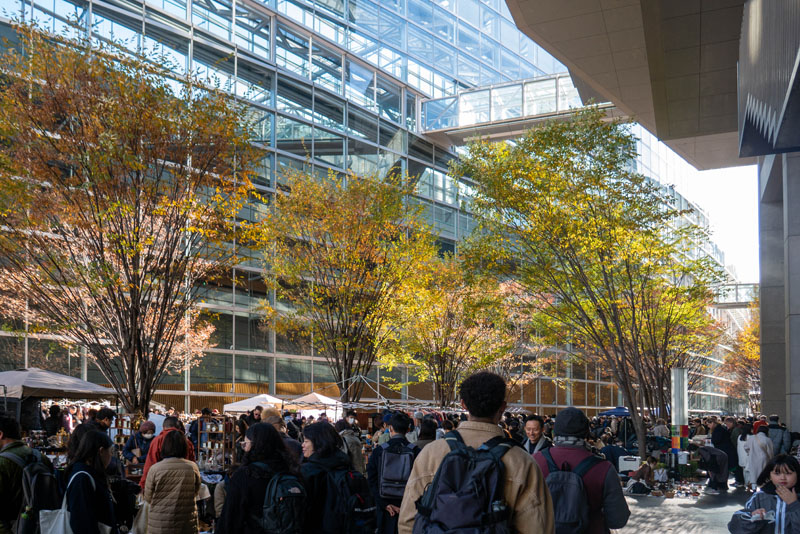
The Oedo Antique Market has actually been around for about 20 years. It first started in September 2003 as a special event to commemorate the 400th anniversary of the founding of the Edo shogunate. The market began at the outdoor plaza of the Tokyo International Forum.
Originally, it was held only on the third Sunday of each month. But because it became so popular, the first Sunday of each month was later added as well. It has now become a regular event held twice a month, and is one of the largest outdoor antique markets in Tokyo.
Since 2012, the market has also occasionally been held at Yoyogi Park. These sessions are not on a fixed schedule, but they are still quite popular. Because of this, you might sometimes see the market location listed as Yoyogi Park on Google Maps. This is why it is very important to check the official website before you go.
Although the Yoyogi Park sessions are rare, if you happen to catch one and go to the wrong location, you could waste a lot of time moving between venues. The two places are not close to each other, and changing plans may affect the rest of your schedule. That’s why it’s important to double-check the location in advance.
Also, be sure to pay close attention to the weather. The market is held outdoors, and most of the items cannot get wet. Even a chance of rain in the forecast can lead to cancellation. It doesn’t have to be heavy rain.
During my second visit, the forecast showed a 60% chance of rain. Since it wasn’t raining when I left, I thought the event would still happen. I walked all the way there from Tokyo Station, only to find no one at the venue. The market had been canceled.
By the way, the outdoor plaza at the Tokyo International Forum is closest to JR Yurakucho Station. Other subway stations are a bit of a walk, so if you want to save energy, it’s best to take the JR line.
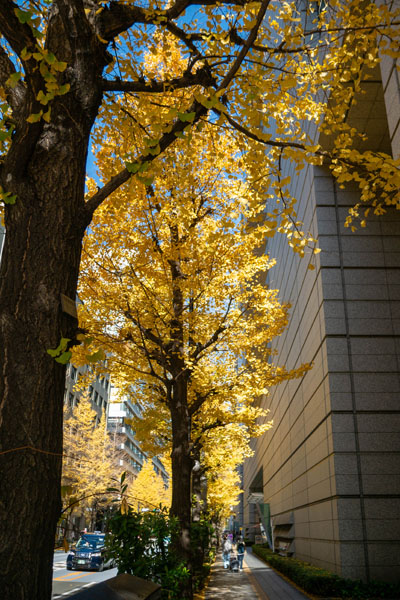
Right next to the venue is a Bic Camera store. The locations of Bic Camera stores in Tokyo are quite far apart, so if you don’t plan to visit areas like Shinjuku or Ikebukuro and still need to shop for electronics, it’s a great idea to stop by after visiting the market.
If you still have energy, you can walk toward Ginza or Tokyo Station for dinner. Two favorite spots for stationery lovers, Ginza LOFT and Itoya, are also on the way and not too far. If you can spend the whole day in this area, it will save a lot of time on transportation.
- Location: Outdoor plaza at Tokyo International Forum (Occasionally held at Yoyogi Park in Shinjuku)
- Dates: First and third Sundays of every month
- Time: 9:00 AM – 4:00 PM (canceled if it rains) For Yoyogi Park sessions: 8:00 AM – 4:00 PM
- Official website:www.antique-market.jp/
- Facebook page:facebook.com/oedo.antique.market/?ref=embed_page#
Plenty of European Small Items: Take Your Time with Accessories and Tableware
While walking through the market, I had the vague impression that the organizers might have intentionally grouped the stalls in a certain way. On the side closer to Yurakucho Station, most vendors seemed to be selling European antiques and accessories. In contrast, the farther you walked from the station, the more Japanese antiques you would find.
Of course, this could have just been a coincidence. European antiques are often small items, so those stalls don’t need much space. Japanese antiques, on the other hand, tend to include larger items like furniture, wooden boxes, or home decor, which naturally need more room. That might be why the distribution appeared this way.
Whether it was intentional or not, the layout made the whole market feel organized. It also allowed me to explore slowly, choosing which areas to visit based on my interests.
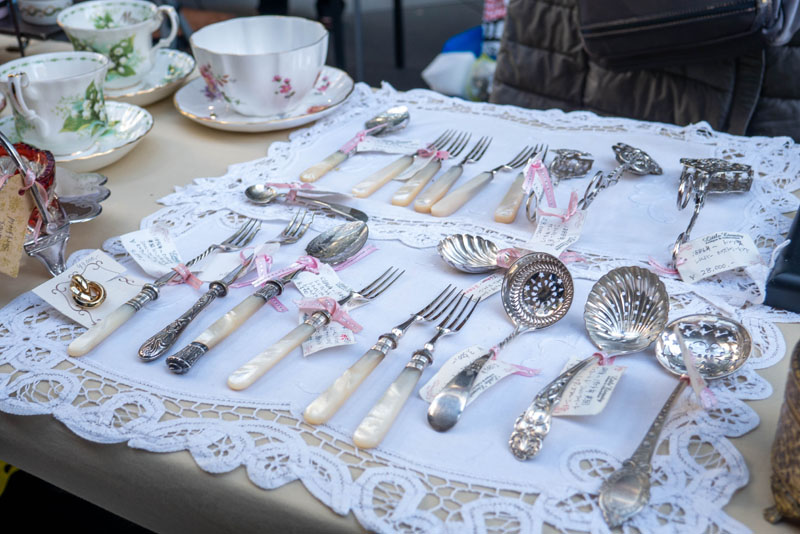
The part of the market that left the deepest impression on me was a long row of tableware crafted from mother-of-pearl and silvery metal. That corner felt as if it were wrapped in a soft glow, being so delicate that it felt almost dreamlike.
I knew from the start that these pieces didn’t belong in my daily life, and they were well beyond my budget. They had the elegance of nobility, yet they sat quietly in the middle of an ordinary market. That contrast was striking and hard to ignore. These were objects that deserved to be treated with care, and certainly not used for soy sauce or left next to the kitchen sink. So I simply admired them, letting their beauty stay right where it was.
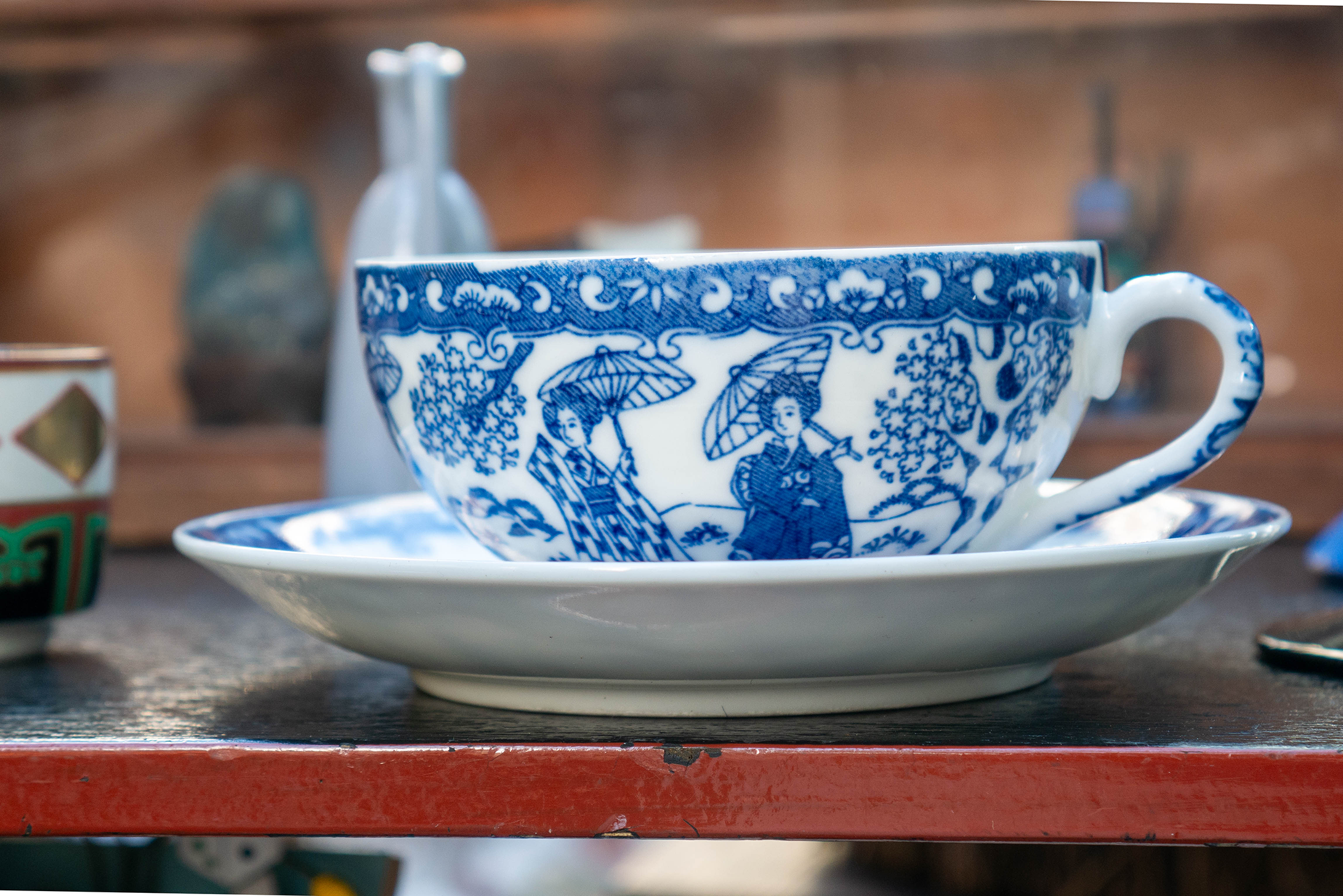
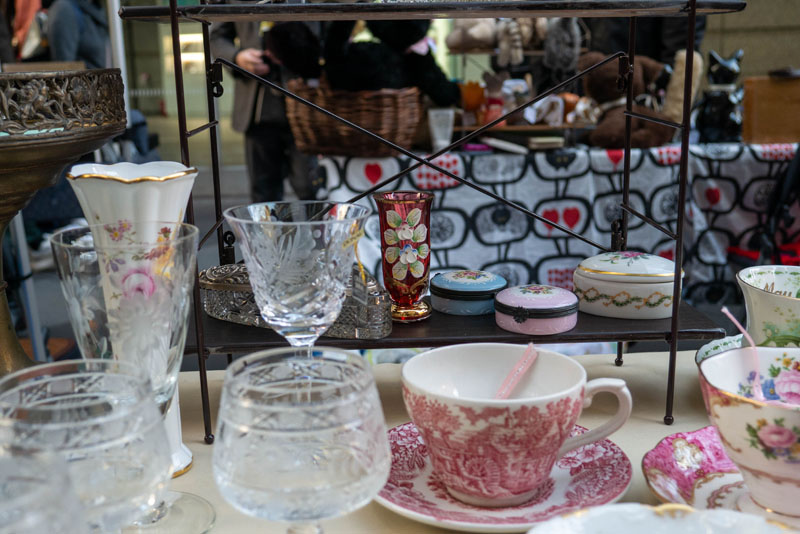
Aside from silverware, I also saw many European antique teacups.
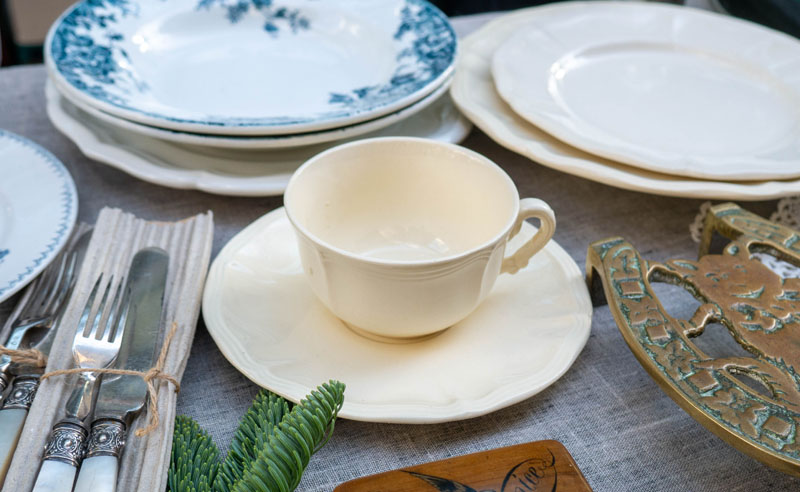
Among them, there was one set in a beautiful Tiffany blue that instantly stole my heart. I loved it so much that I gathered my courage to ask for the price. The vendor told me it was nearly 15,000 yen. All I could do was smile politely and apologize; I had to settle for taking a photo to remember it. It was truly a wonderful set, but sadly, my wallet wouldn’t let me take it home.
There were also a few plush bears in excellent condition. They had the feel of luxury teddy bears, looking almost like something on loan from a museum. Some of them were truly charming, not just because they looked cute, but because of the details and texture that only older toys have. Those qualities are rarely found in today’s mass-produced soft toys. Being able to see them up close at a market like this felt special and very worthwhile.
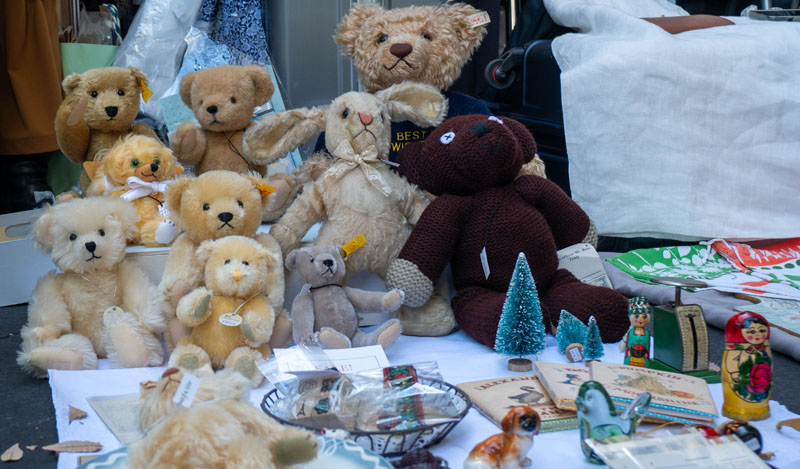
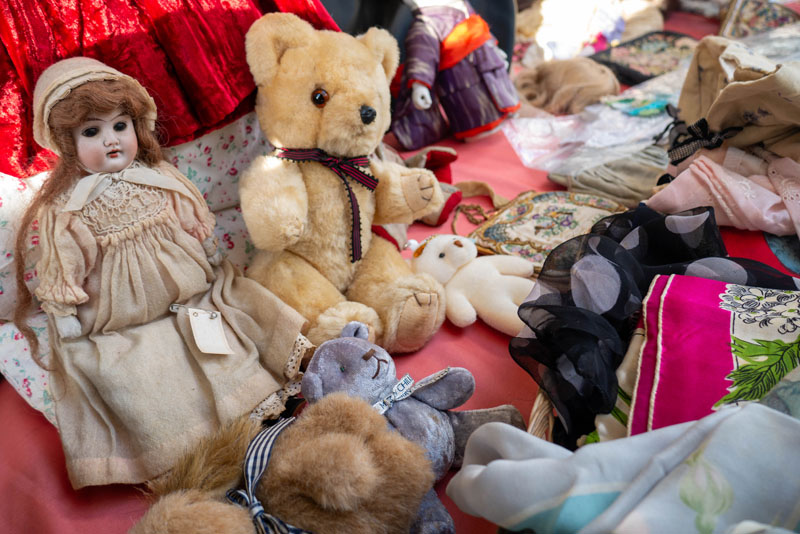
In addition to tableware and toys, there were also many stalls selling accessories. From vintage brooches and hair clips to silver jewelry and intricately crafted earrings, the variety was impressive and densely packed.
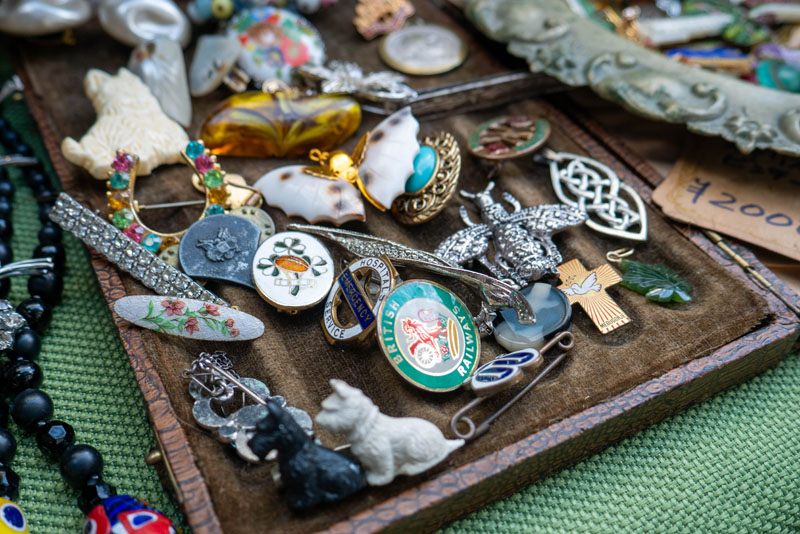
Maybe it is because I’ve helped organize markets in the past that I feel a special connection to vintage accessories. This time, I browsed the stalls more carefully than usual. Many of the pieces on display clearly reflected European styles from around 80 to 90 years ago, during the height of Art Nouveau and Art Deco. That era was known for its bold and expressive designs with rich details. In Japan, this period roughly corresponds to the late Meiji and Taisho years. When these styles came to Japan, they evolved into what people now call the “Taisho Roman” aesthetic.
Kimono from that time often featured daring colors and patterns, which remain popular among today’s younger generation. Some obi belts even replicate the original styles from that period, but of course, the price makes them hard to afford. I could only admire them from afar.
At this market, the accessories felt like more than just fashion items. They were fragments of time, each carrying delicate engravings, geometric shapes, or religious symbols. Seeing all these designs side by side made me appreciate the energy and spirit of craftsmanship from the past. The ones that caught my eye most were Damascene pieces with an exotic Eastern look.
I learned to recognize this style back when I was involved in market organizing, so it stood out immediately. Although I’ve always admired the fine details and elegance of Damascene work, I don’t usually wear accessories myself. I simply enjoy the beauty of handcrafted art.
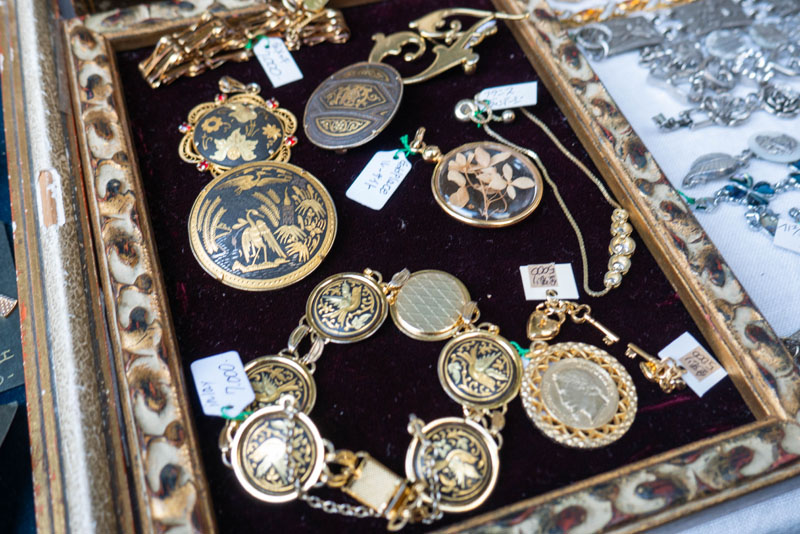
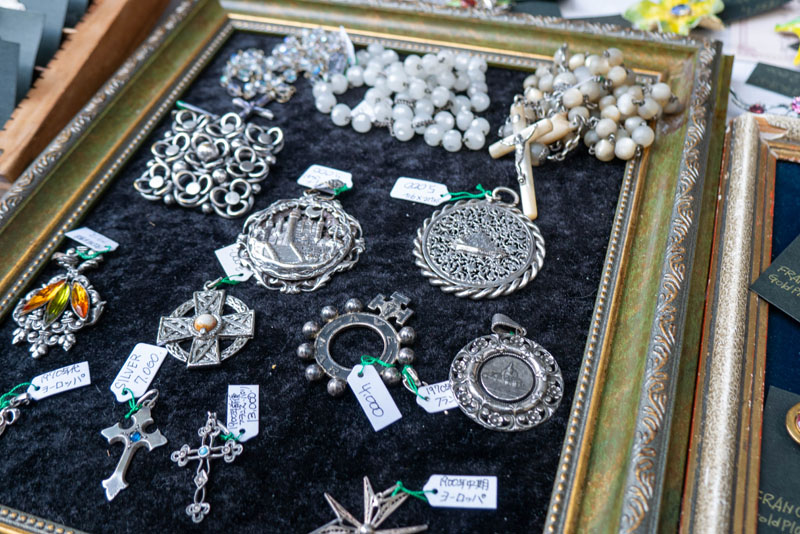
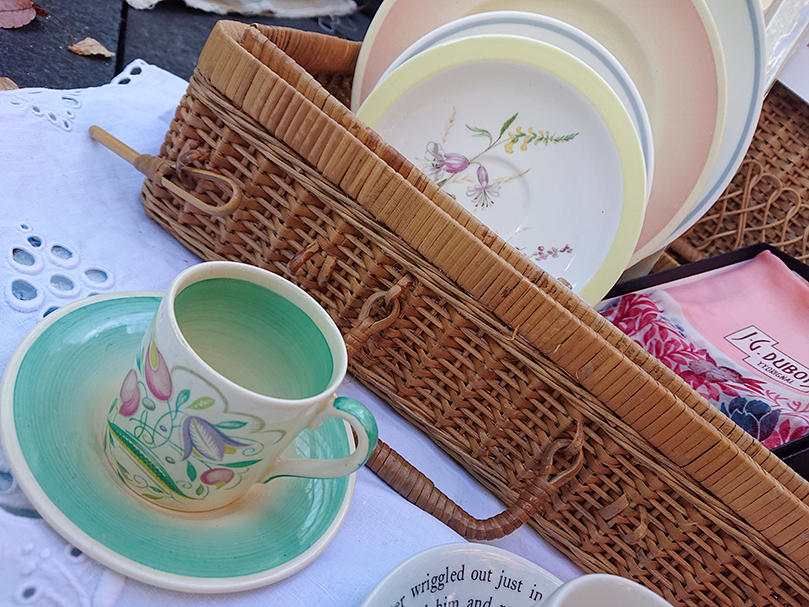
As I wandered among these accessories and tableware, it felt as if I could catch glimpses of past elegance through the patterns, hand-carved details, and softly yellowed sheen of each item. Alongside the free-spirited designs of vintage jewelry, the market was also filled with refined tableware, such as hand-painted floral porcelain cups, vintage engraved silverware, thick old glass tumblers, and delicate ceramic plates. Each piece reflected the craftsmanship and taste of its era.
The entire atmosphere of the market felt like fragments of time scattered throughout. Whether it was an enamel brooch or an old silver fork, everything carried a quiet charm. For those who love vintage fashion or have a passion for old objects, this kind of market is like a treasure trove where different times overlap, quietly adding a touch of nostalgic romance and unique character to everyday life.
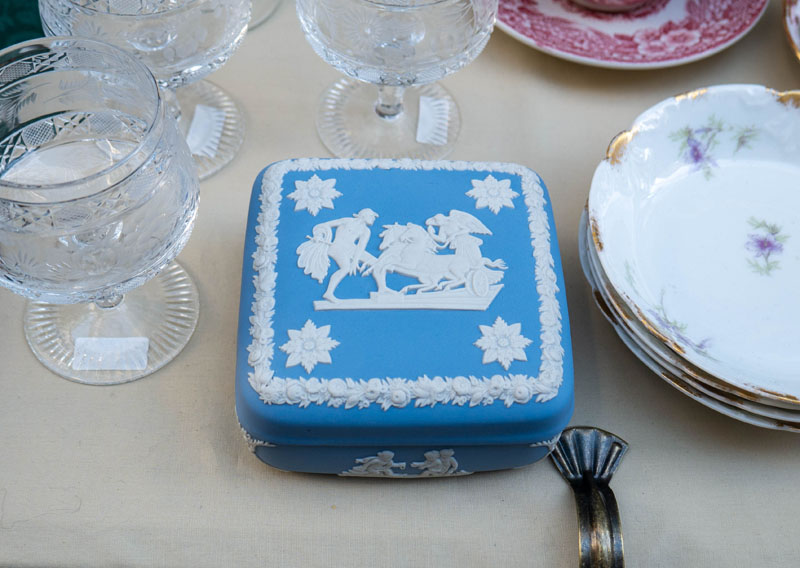
Besides the many small accessories, I also came across a few large furniture pieces and decorative items scattered throughout the market, usually placed in areas farther from the station. Although these items were fewer in number, they were all of very good quality.
Sometimes I would stop to take a closer look, and I couldn’t help but feel tempted to buy something. But reality quickly reminded me that I had no space to place these items at home, and they would definitely make my luggage overweight if I tried to bring them back.
Japanese Antiques and Secondhand Kimonos Worth Browsing
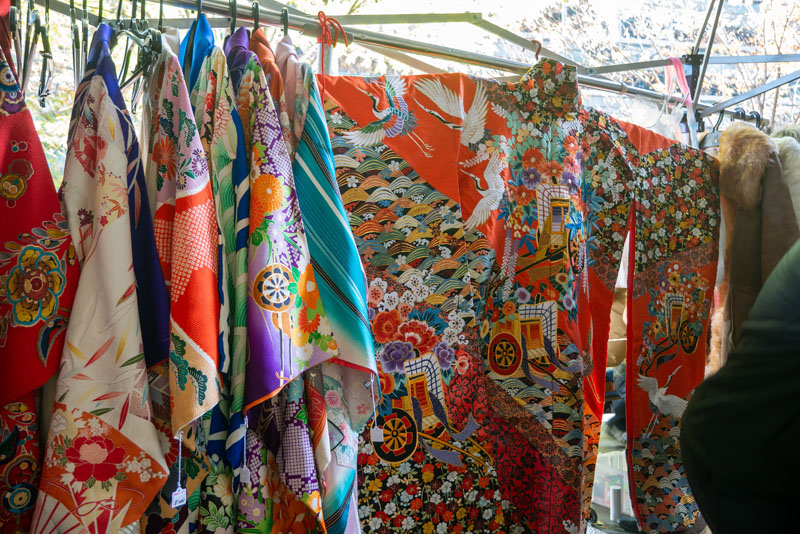
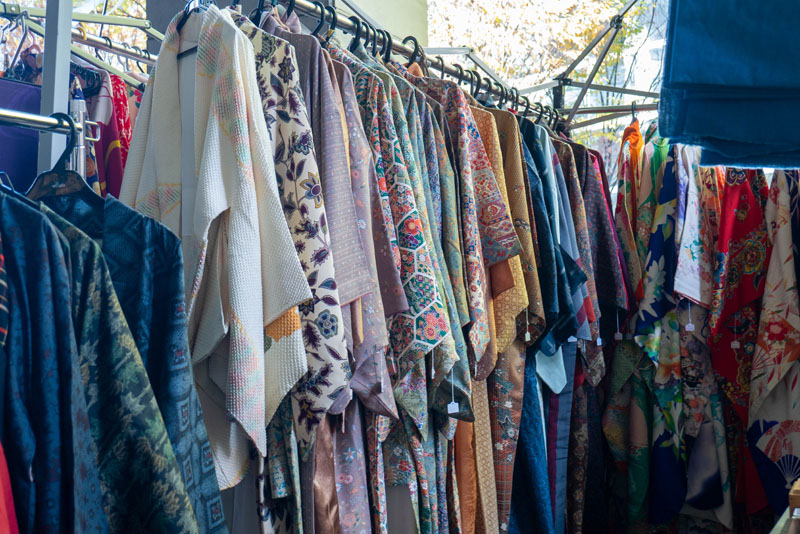
Although the number of kimono stalls at this market was not particularly high, the way they were set up and the overall atmosphere clearly showed the organizers’ attention to detail. Most of the kimono-focused stalls were placed in shaded areas, which is especially important for protecting silk kimono that can be damaged by sunlight. Not every stall had full cover, but at least the majority were thoughtfully positioned to avoid direct exposure.
This kind of careful planning made it feel like more than just a typical secondhand market where vendors simply lay things out. The stalls themselves were also well-organized. Each kimono was neatly hung according to its color or fabric, so there was no need to bend down and dig through piles like at a flea market.
Judging by their condition, most of them were quite clean. Even when I stepped inside the stalls, I could hardly detect the usual musty smell that often comes with secondhand kimono. Maybe it was because of the good outdoor airflow, or maybe these garments had simply been well preserved. Either way, browsing felt especially easy and pleasant. The prices were not extremely low, but considering the quality and cleanliness, I felt it was fair to pay a bit more. After all, these garments were once someone’s treasured belongings, and the fact that they were preserved so well means they deserve to be treated with respect.
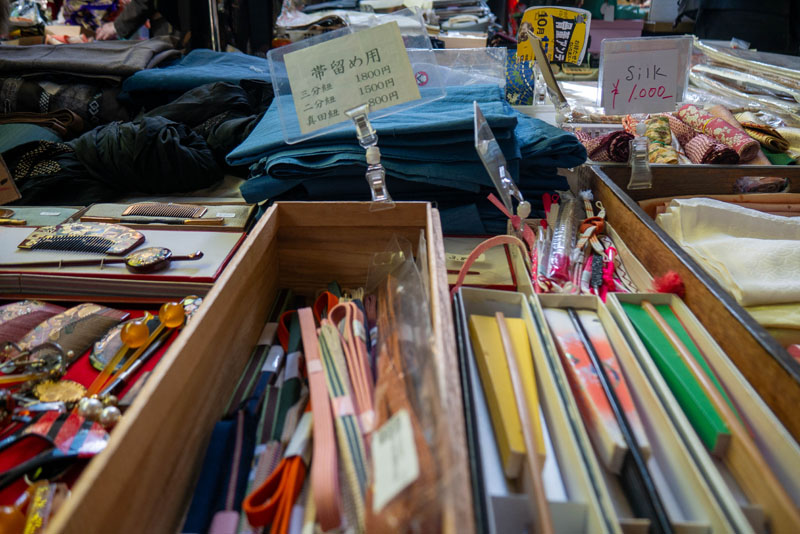
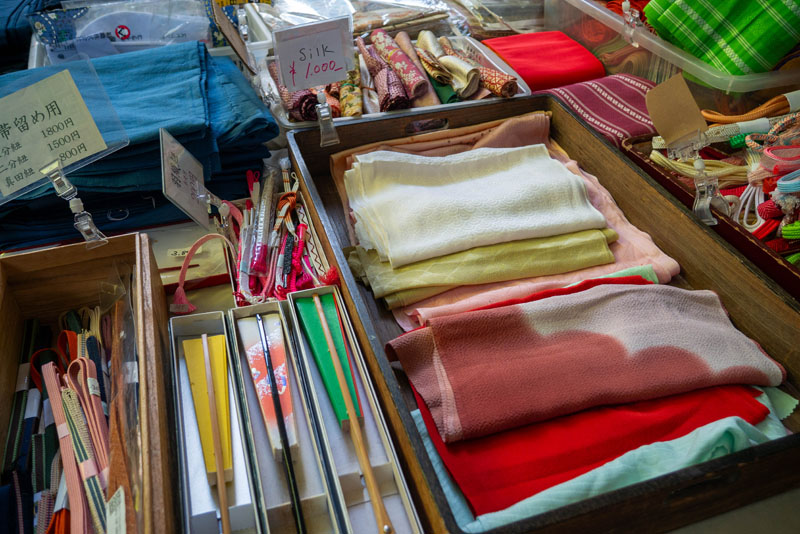
What really surprised me was the variety of everyday kimono accessories available at the market. There were quite a few practical items that are usually hard to find, such as obiage( 帶揚 ), Sanada cords( 真田紐 ), and sanbu-himo( 三分紐 ). I was especially happy to see that not all the obiage were shibori-dyed for once. While shibori is beautiful, it is not something you often wear in casual coordination. Basic designs are much more practical for everyday use, yet they are rarely seen in secondhand markets.
That is why I was especially glad to come across sanbu-himo. Since I am on the larger side, regular obijime( 帶締 ) cords are often too short for me. Sanbu-himo are not particularly long either, but they are just enough to keep things in place, which makes them very useful in my case. Finding Sanada cords as well made me feel that this market really had a lot to offer in terms of useful choices.
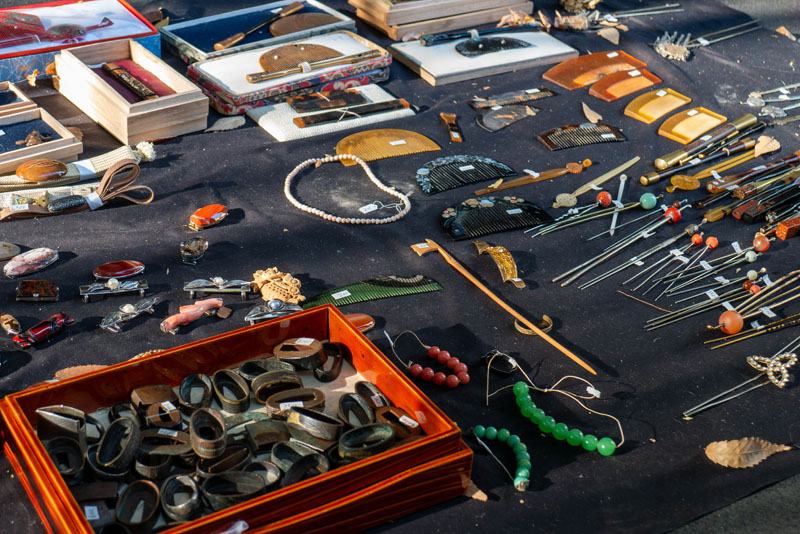
There were also a few small stalls selling kanzashi (traditional Japanese hairpins), and their displays were fairly well arranged. However, to be honest, the kanzashi I saw earlier at the Aozora Market in the morning felt more refined in terms of craftsmanship.
The layout at Aozora was a bit more casual and didn’t catch the eye right away, but if you looked closely, the details were quite delicate. In contrast, the stalls at the Oedo Market looked easier to browse at first glance, but on closer inspection, the pieces didn’t feel as finely made. Yet, the prices at both markets were surprisingly similar. As a result, I didn’t end up buying anything, and now I slightly regret not going back for the ones I saw earlier.
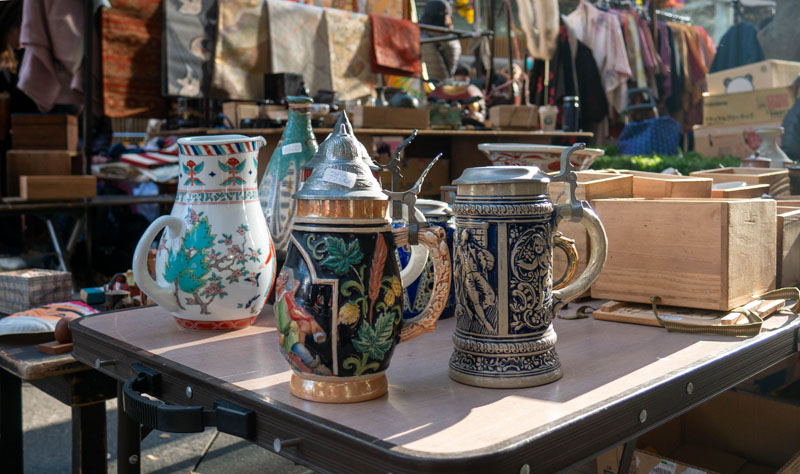
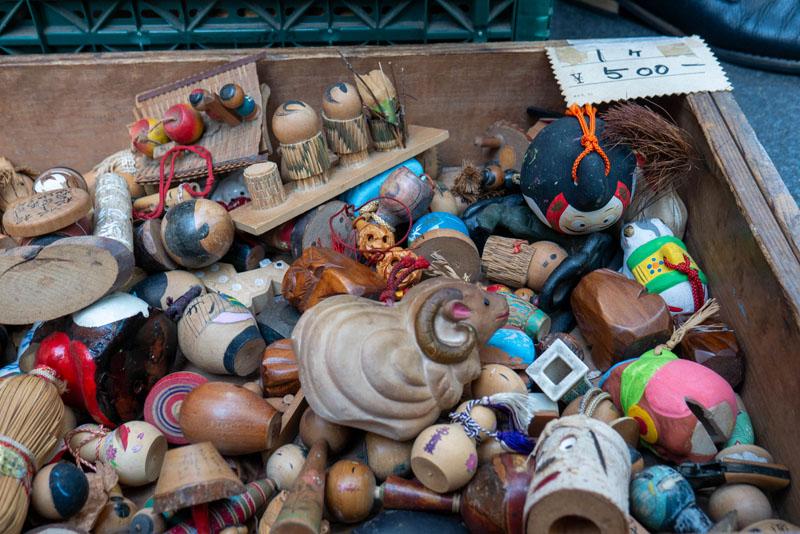
As I walked further into the Japanese antiques section, the variety became even more diverse. There were tea ceremony utensils, wooden boxes, lacquerware, and all kinds of decorative items. Although the scale wasn’t as concentrated as the antique markets in Kyoto or Osaka, the range of items was still impressively rich. What touched me the most were some old wooden toys. These items, no longer popular today, carried a warm and quiet texture that only time could create. It is hard to put into words, but that aged wood feeling drew me in, and I couldn’t help stopping to take a closer look.
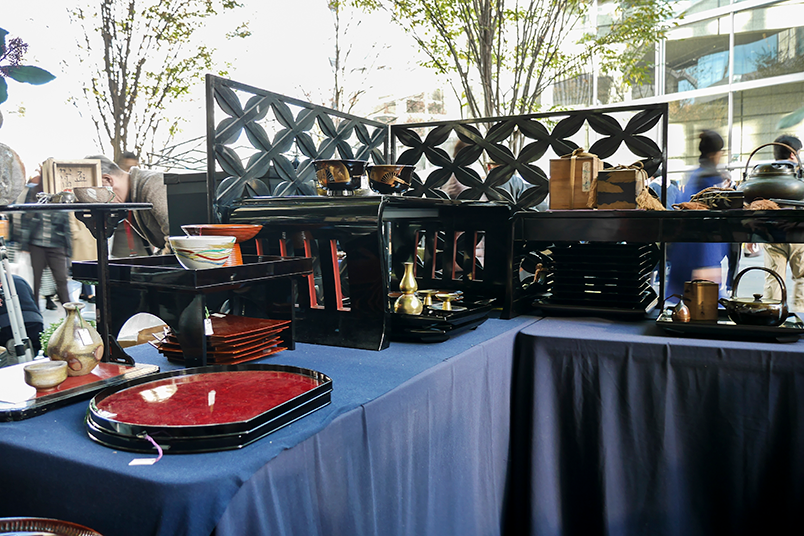
What touched me the most were some old wooden toys. These items, no longer popular today, carried a warm and quiet texture that only time could create. It is hard to put into words, but that aged wood feeling drew me in, and I couldn’t help stopping to take a closer look.
Overall, the Japanese antique stalls here shared a common trait: there were plenty of items, but the layout never felt messy or overcrowded. Each stall seemed carefully curated and arranged, with enough space between items to browse comfortably. It didn’t have the kind of thrill where you dig through boxes and unexpectedly find a hidden gem, but for regular visitors, this setup is probably more enjoyable. For those who prefer to quietly look around and take their time choosing, this kind of market atmosphere is ideal.
An Unexpected Delight: Discovering Wagashi Wooden Molds
What surprised me the most that day was stumbling upon a stall that specialized in wagashi wooden molds. These kinds of stalls are extremely rare, and even in long-running antique markets in Kyoto or Osaka, you might not come across one. I never expected to find it at an open-air antique market in Tokyo. The moment I saw it, my eyes lit up and I instantly felt more energized.
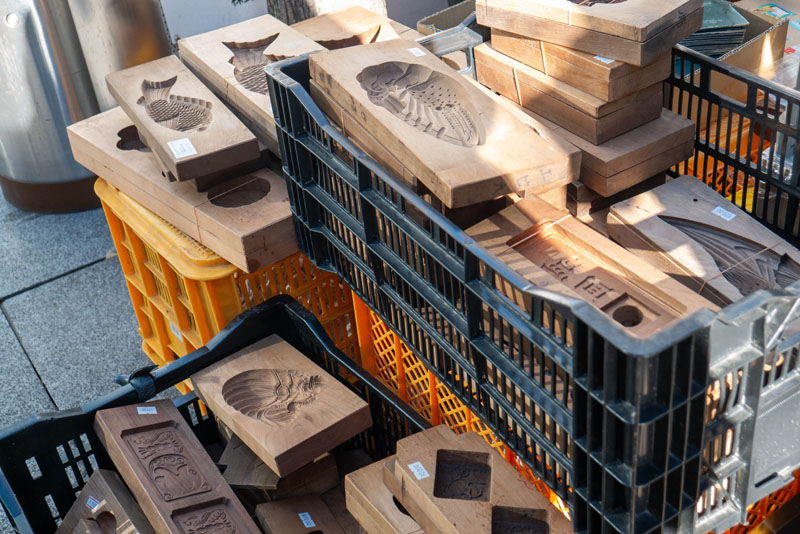
The molds on display were much larger than I had expected. Maybe it is because wagashi in earlier times were made bigger, unlike today’s trend toward smaller and more delicate designs. Some of the wooden molds still had finely carved patterns along with a soft sheen developed over years of use. Each piece carried a quiet, rustic beauty that is hard to put into words.
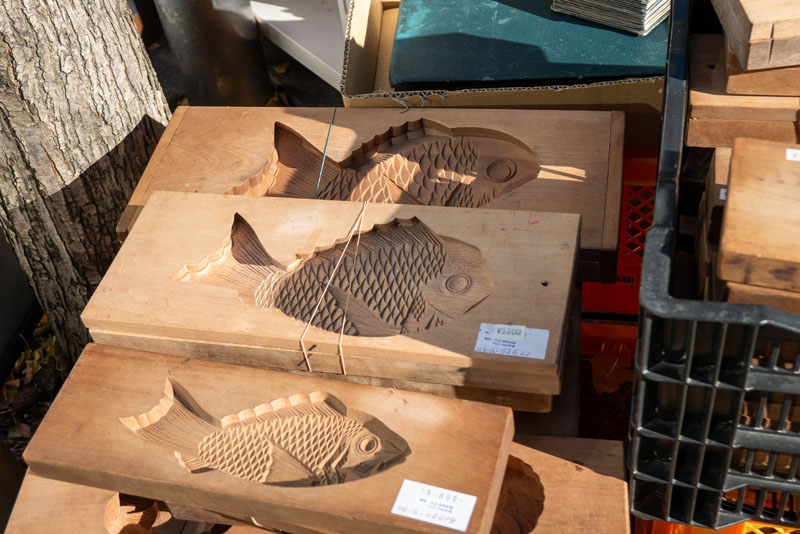
This ended up being the stall where I searched the most seriously, even more focused than when I was looking for kimono accessories. I originally hoped to find a few molds with delicate embossed patterns, but those might be more modern designs, as most of the pieces on site featured traditional carved motifs.
I went through basket after basket and finally found a simple sensujiban (a board for pressing fine parallel lines). The design was plain, but the overall condition was excellent, which made it feel like a worthwhile find.
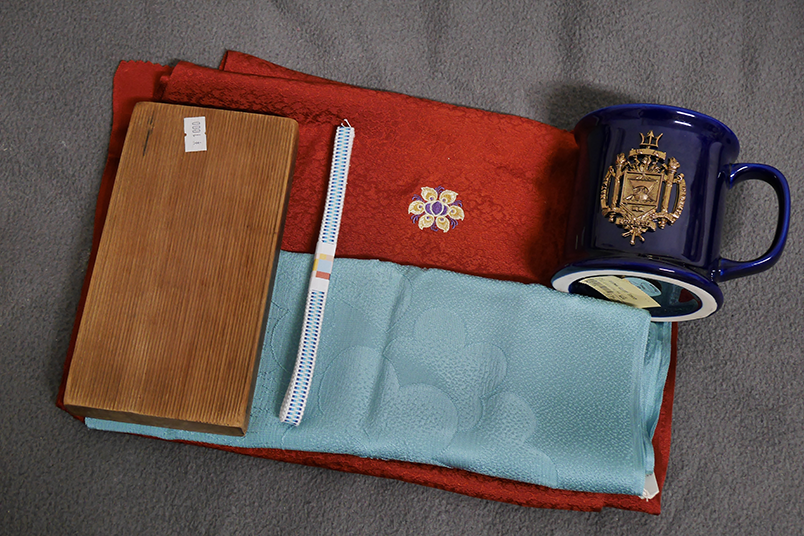
What I regret the most, however, is not picking up a few of the plain wooden molds that were in good condition. The wood used for wagashi molds is usually very carefully selected; even blank wooden boards without patterns are not cheap because of the quality of the material itself. Now that I think about it, those plain pieces could have been useful in the future, whether for replacements or custom carving. This kind of “I should have bought it when I had the chance” feeling always hits harder at markets like this because deep down, you know that some things, once missed, might never show up again. Especially with a stall this rare and practical, I really should have taken home a few more pieces.
Conclusion: An Afternoon at a Nostalgic Market, Where Only Those Who Pause Can Truly See the Scenery
After spending the whole afternoon at the market, I realized that what makes the Oedo Antique Market truly appealing is not just the items themselves, but the relaxed pace and pleasant atmosphere it offers. By the afternoon, many of the best finds might have already been picked up by early visitors. However, most of the items here are meant for personal enjoyment and collecting rather than resale. Everything feels carefully selected and thoughtfully arranged.
Although the prices are not exactly cheap, the quality and condition of the items are generally very good. What stands out most is the wide variety. Whether you are drawn to nostalgic Japanese goods or have a soft spot for European antiques, you can definitely find a corner of the market that feels like it was made for you.
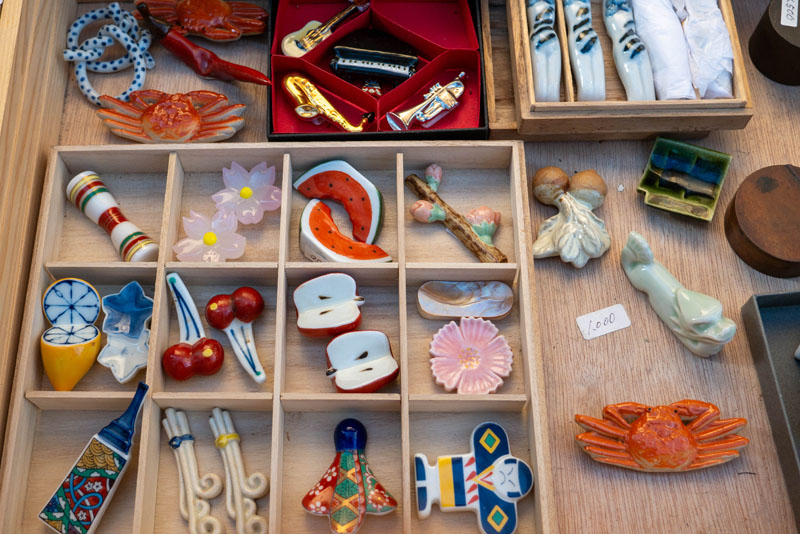
The accessories section was especially impressive, with many designs dating back to the last century. Although the prices were on the higher side, they were still quite reasonable compared to similar items sold in Taiwan. For those who love vintage pieces and enjoy thoughtful styling, this market is definitely worth a visit. Personally, I spent a lot of time just at the accessories stalls and the wooden mold stall. The process of weighing practicality against collectible value felt less like shopping and more like having a quiet conversation with each object.
If you get tired, there is no need to worry. Since the market is held in the business district of central Tokyo, the venue is surrounded by cafés and restaurants that make it easy to rest. In the summer, the air conditioning in these shops can feel like a lifesaver. Even if you do not enter the shops, there are plenty of benches around where you can sit down, sip a drink, and take a break. This level of comfort and convenience is a big step up from markets held in open parks, which might be one of the reasons the organizers have chosen to keep the main venue here.
As they explain in their mission statement, the market aims to renew appreciation for antiques, offer opportunities to rediscover Japanese culture, and create a space for people to connect through art and tradition. A market visit should be a calm and enjoyable everyday experience rather than a physical endurance test. This is what makes the Oedo Antique Market so charming: it offers a rare chance to rediscover the beauty of the past in a truly pleasant setting.
*Unless otherwise noted, all photos in this article were taken by the author (yanshoto.com) during personal travels and are fully copyrighted. Please do not reproduce or use them for commercial purposes without prior permission. Thank you for your understanding and respect.
Nearby Accommodation Experiences (This link leads to a page written in Chinese only.)
- Staying Solo at Juyoh Hotel: A Japanese-Style Single Room and a Convenient Tokyo Base Starting from Minami-Senju Station
- Staying Solo at Hotel Accela: A Convenient Location near Minami-Senju Station, with Skytree Views from the Women-Only Floor and a Surprise Encounter with the Sanja Matsuri at Asakusa Shrine
Related Market Articles (This link leads to a page written in Chinese only.)
- Aozora Market at Tokyo’s Hanazono Shrine: A Morning Stroll Through Antiques on a Carpet of Ginkgo Leaves
- An Evening Stroll at the Toshi-no-Ichi in Asakusa, Tokyo: Experiencing the Year-End Atmosphere of Edo Traditions
- Exploring the Setagaya Boro-ichi in Tokyo: A Winter Tradition Held Only Twice a Year and Designated as an Intangible Folk Cultural Property of Tokyo
- Zoshigaya Handmade Market & Otori Shrine Visit (Part 1): A Winter Afternoon of Temple Markets, Dango Tasting, and a Visit to Yumeji’s Grave
- Zoshigaya Handmade Market & Otori Shrine Visit (Part 2): Year-End Prayers Among Ceramics and Winter Sunlight at a Local Shinto Shrine
✦ 喜歡這篇文章嗎?
《煙雲漫筆》的每月慢信會收錄這樣的片段,也會分享一些未公開的草稿與旅行筆記。
如果你也想一起閱讀,歡迎留下信箱。