- Exploring the National Palace Museum: From Dining to Cultural and Creative Finds - 2026-10-29
- A Magical Visit to Kinomiya Shrine in Atami: A Helpful Omikuji and a Healing Journey Beneath a Thousand-Year-Old Camphor Tree - 2026-10-22
- Where to Return Omamori in Japan: Notes on Shrines with Old Amulet Collection Boxes 01 - 2026-10-15

This time, I decided to visit the National Palace Museum (國立故宮博物院) like a traveler, instead of just coming to see the exhibitions. In the past, I usually finished looking at the exhibits and left right away. This time, I also spent some time learning about the museum itself, especially its dining options. I am glad I did some research and decided to eat inside the museum. Taipei is extremely hot in June, and going outside to find food in the middle of the day would have been very tiring.
I used to think that many products at the National Palace Museum looked nice but were not very useful. This time, I took a much closer look. Some items still seem to focus more on appearance, but I also found quite a few creative and interesting products. After looking around, I still think the museum’s books offer the best value. The printing is beautiful, the books are thick and well made, and some are even cheaper when bought online.
Personally, however, I am still more interested in clothing and jewelry. I may not be able to afford the real pieces, but it is still fun to look at products inspired by them. Unfortunately, I did not find anything related to Refined Radiance: Treasures of Qing Dynasty Jewelry (妙色—清代金銀飾件特展), which is now being shown at the Southern Branch of the National Palace Museum (國立故宮博物院南部院區). Some items in the exhibition are borrowed from the National Museum of Taiwan History (國立臺灣歷史博物館) and the National Museum of History (國立歷史博物館), so perhaps that is one reason. It was still a little disappointing.
This change in mindset also made my trip to Taipei for an incense ceremony course feel much more relaxed. I took the time to eat properly and get enough rest. More importantly, I decided that I can always come back to the museum again. When some of the permanent galleries were too crowded, I simply skipped them instead of forcing myself to see everything in one visit.
I would like to come back when it is less crowded, but I am not sure that is easy at the National Palace Museum. Even on a weekday, some galleries already felt very crowded. I can hardly imagine how busy it becomes on weekends. Next time, I will definitely arrive earlier. It should be easier to avoid large tour groups and enjoy the exhibits without having to move around constantly just to find a clear view.
- A Quick Guide to Visiting the National Palace Museum: Luggage Storage, Routes, and Ticket Discounts
- My First Visit to Xianjufu Café (閑賦居): An Affordable Lunch Inside the Museum
- National Palace Museum Shop Finds: A Pleasant Surprise with the “A Cat amidst the Crimson Plum Blossom” (紅梅貍奴) Phone Pouch
- Final Thoughts: Museum Visit Notes and Travel Tips
A Quick Guide to Visiting the National Palace Museum: Luggage Storage, Routes, and Ticket Discounts
It had been a long time since my last visit to the National Palace Museum, so I called the museum before my trip to ask about luggage storage. The staff told me that lockers are available inside the museum. If your luggage is too large for a locker, you can also leave it at the service counter. Best of all, both services are free. I remembered that luggage storage had always been free, but it was still nice to hear this directly from the staff.
At first, I thought about leaving my suitcase at the hotel. However, there are buses from the museum that can take me toward Taipei Bus Station. Going back to the hotel just to pick up my luggage would mean making a detour, so I decided to bring my suitcase with me.
Of course, the trip did not go exactly as planned. Only a few buses, such as R30 and BR20, stop directly at the B1 entrance of the NPM Main Building. Most other buses stop farther away, so there is still a fairly long walkway and several sets of stairs before reaching the main entrance. I was a little shocked when I got off the bus and saw the route ahead of me. Luckily, this was only a trip within Taiwan, so I had brought just a small carry-on suitcase. It was not too difficult to handle, and I guess that is one advantage of traveling close to home.
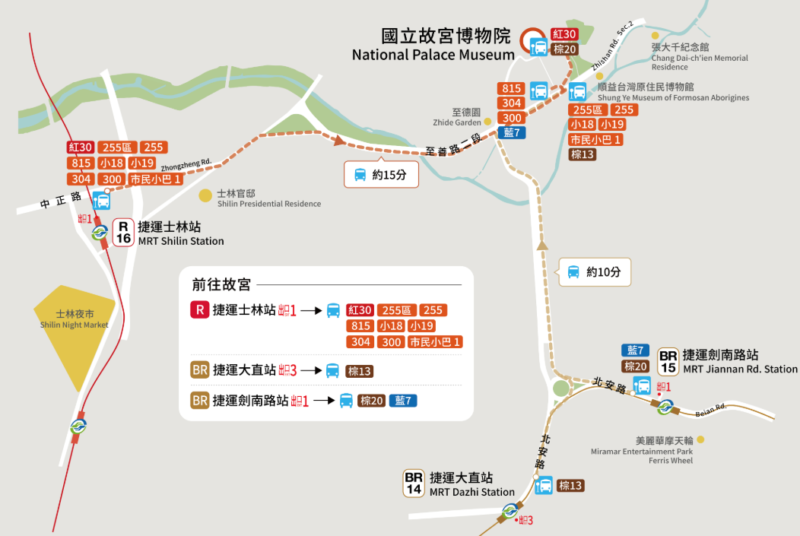
When I entered the first floor of the main building, I realized that the layout was actually very convenient. Xianjufu Café (閑賦居) is on the right, the luggage storage area is in the middle, and the ticket counter and audio guide rental counter are on the left. The three things I needed most on this visit, storing my luggage, buying a ticket, and finding the café, were all right near the entrance. Everything was easy to find and very convenient.

I was a little worried that the lockers at the National Palace Museum might be too small, but the large locker was much more spacious than I expected. My 20-inch carry-on suitcase fit easily, and there was still enough room for my large backpack.
I had been prepared to use two lockers, so this was a nice surprise. There are two locker sizes: the smaller one is 46 × 42 × 32 cm, while the larger one is 46 × 76 × 32 cm. The lockers are quite deep, which is why I was able to fit both bags inside more easily than expected.

One last tip for Taiwanese visitors: do not rush to buy your ticket online. The National Palace Museum offers a discounted ticket for Taiwanese citizens. By showing a valid ID, the ticket price drops from NT$350 to only NT$150. The difference is quite large, and the money you save is almost enough for a coffee at Xianjufu Café. To avoid any problems at the ticket counter, I recommend bringing your National ID card.
For foreign visitors, the regular admission price is NT$350, but there are still a few ways to save money. Foreign residents with an Alien Permanent Resident Certificate (APRC) and students with a valid International Student Identity Card (ISIC) can also buy the NT$150 discounted ticket. Visitors under the age of 18 can enter for free regardless of nationality.
My First Visit to Xianjufu Café (閑賦居): An Affordable Lunch Inside the Museum
Xianjufu Café (閑賦居) was one of the main reasons I wanted to spend more time at the museum this time. On my previous visits, I usually brought my own food and ate outside because Sanxitang Space (三希堂) was too expensive for me. This time, I wanted to relax and enjoy a proper meal, so I first planned to eat at Sanxitang Space. However, after seeing the prices, I quickly changed my mind. I do not even spend that much on meals when I travel abroad.
While looking for another place for lunch, I found Xianjufu Café. The museum website did not show a menu, so I checked a few reviews online. The menu may change, but the prices are usually much more affordable than Sanxitang Space. They are closer to what I would normally pay at a brunch café, so I decided to have lunch here instead.
To avoid the lunch crowd, I entered the café at around 11:40 a.m. I was glad I came early because more people started arriving as soon as noon came. When I finished my meal and left, there was still a line even after 2 p.m. There are not many places to eat around the museum. Other than Xianjufu Café, the main choices are Silks Palace (故宮晶華) and Sanxitang Space.
I was also very glad that I chose to eat inside the museum. It was extremely hot that day, and I really did not want to leave the main building. Going outside for lunch in the middle of a Taiwan summer would have been exhausting. The midday heat here is no joke.
I ordered a smoked chicken and cheese sandwich with coffee and a chocolate mille crepe cake. The total was around NT$270. At first, I thought only the rice dishes could be upgraded to a set meal. When I went to pay, I noticed that sandwiches could also be upgraded, and the extra cost was even a little cheaper than ordering an Americano separately. So I chose the set meal instead.
If you want a more filling meal, you can also add a salad to a main dish for only NT$79. The portion was about two to three times larger than the salads I usually see at convenience stores. The ingredients were fairly simple, with lettuce making up most of the bowl, but for the price, I still thought it was a very good deal.

I originally wanted to try one of the rice dishes, but they cost almost twice as much as the sandwiches. After comparing the prices, I realized that adding another NT$100 to NT$200 would already bring the total close to a meal at Sanxitang Space (三希堂), so I decided to order a sandwich instead.
I expected a regular toast sandwich, but it turned out to be more like a submarine sandwich filled with lettuce, smoked chicken, and cheese. The portion was quite generous, and the bread was toasted until crisp. It was filling enough to leave me about half to two-thirds full.

I also ordered a chocolate mille crepe cake, which made the meal feel just right. The cake itself was fairly average and not quite as good as the mille crepe cakes from Tanaluki (狸小路), but the presentation made it look much nicer.
I especially liked the simple plates used at the café. They were all plain and elegant, and I wondered if the design was inspired by the beauty of Ru ware (汝瓷). The National Palace Museum also uses the term “Ru ware” in its English materials. Somehow, almost any food placed on these simple plates looked good.

The Americano had a stronger roasted flavor, but it was still lighter than many of the coffees I have had in Japan. This is not really my favorite style of coffee, but it was still acceptable. After drinking so many strong and bitter coffees in Japan, I think I have become used to this kind of taste.
Next time, I would like to try one of their hot drinks instead. The cups for hot drinks also looked nicer and more elegant, which made me want to order one just to take a photo of the cup. Overall, the food and drinks at Xianjufu Café were better than I expected.
The choices are limited, but the café does not feel like a place that serves tourists carelessly just because there are not many other options nearby. At least I never felt that I was paying too much for what I got. I still cannot believe I had overlooked this café before and ended up eating outside in the wind several times. Looking back, that was much more inconvenient than it needed to be.
National Palace Museum Shop Finds: A Pleasant Surprise with the “A Cat amidst the Crimson Plum Blossom” (紅梅貍奴) Phone Pouch
While walking through the exhibition galleries, I passed several small souvenir shops and noticed a purse inspired by A Cat amidst the Crimson Plum Blossoms (紅梅貍奴) that caught my attention. I was also thinking about buying a book to read more about the collection. So before leaving the museum, I decided to spend some time looking through the museum shops properly.
In the past, I usually skipped these shops because I felt that many cultural and creative products in Taiwan focused more on appearance than practical use. This time, however, I was surprised by how much the selection had grown. Many stationery items still seemed to rely mainly on designs taken from famous artworks. Some notebooks, for example, looked nice but used fairly ordinary paper. The planners seemed better in both design and quality, but since half the year had already passed, I decided to wait until the end of the year before considering one.
A few products still caught my attention. One was the Dwelling in the Fuchun Mountains Pen Holder and Business Card Stand (富春山居圖筆插名片座). Its design reminded me of the Little Boy YIA Weekly Memo Pad (小男孩 YIA 周記便條紙) I bought before, but this one looked even more practical and took up less space. You simply place a business card or note into the cut-out section, and it stands upright. Unfortunately, this product appeared a little too late for me because I already have something similar at home, so I still need to think about whether I really need another one.
Another interesting item was the Blue-and-White Camellia Bookmark (青花山茶書籤). It can be attached directly to the corner of a page, and a small handle makes it easy to find where you stopped reading. The pattern was not really my style, but I liked the idea and thought the design was very practical. Then I turned it over, saw the price, and quietly put it back on the shelf.

As I continued browsing, I finally reached the second-to-last section and found the A Cat amidst the Crimson Plum Blossoms (紅梅貍奴) collection that I had also seen in the exhibition galleries. The series included several embroidered cat bags in different sizes, and I kept comparing them. Every size had something that made me hesitate, so I could not decide at first.
Then I saw the phone pouch and finally made up my mind. I had actually thought about buying a phone pouch before, but I always ended up choosing a crossbody bag from Goshiki Hanpudo (五色帆布堂) instead.
What I liked about this phone pouch was the way the original horizontal artwork had been redesigned into a vertical shape. Much of the empty space was removed, so the overall balance and composition looked much better than the other bags in the same series. That was enough to make my decision, and I finally brought it home with me.

Just before leaving, I noticed the NPM × Jhentea Whisking Tea Set (故宮 x Jhentea靜心點茶體驗組) in a display case. The glass tea pitcher immediately caught my eye, and I thought the whole set looked very well put together. However, once I saw the price, I decided to admire it from a distance. I think I will just keep using my small teapot at home. After all, I usually drink tea by myself, so there is no need to make things too complicated.

For visitors who enjoy collecting souvenir stamps, the National Palace Museum has a stamping area next to the service desk on B1. There are four different stamp designs, placed on separate tables. Each table also has a soft pad, so you only need to press lightly when stamping. The only thing I found a little disappointing was that most of the designs focused on objects from the museum collection. I think it would be even better if some of the stamps also included more elements that represent the National Palace Museum itself.

Final Thoughts: Museum Visit Notes and Travel Tips

Next time I visit the National Palace Museum, I really need to remind myself not to bring luggage unless necessary. The museum offers free lockers, and larger bags can also be left at the staffed luggage counter. Even so, simply pulling a suitcase all the way to the museum was enough to make me sweat. For first-time visitors, it may also take some time to find the easiest route.
I only discovered the ramp on B1 when I was about to leave. It makes the walk easier, but there is still a short set of stairs at the end. If your suitcase is very heavy, I would still recommend leaving it at your hotel in the city. Visiting the museum without luggage is much more comfortable, and it is easier to enjoy the exhibitions.
Another thing I noticed was how crowded the buses to the museum can be. I expected a weekday to be quieter, but the bus was still quite full. Bringing a suitcase onto a crowded bus felt a little awkward because it took up extra space. Luckily, there were fewer passengers on my way back, so traveling with luggage was much easier.
For lunch, I strongly recommend arriving early if you want to eat at Xianjufu Café . On normal weekdays, there is usually no strict dining time limit. However, during major or international exhibitions, the café may introduce time limits. It is worth checking the latest information online before your visit so you can plan your meal and avoid missing the best time to eat.
This time, I visited the National Palace Museum with more of a travel mindset, and it changed the whole experience. I realized again that museums in Taiwan are quite affordable, especially with special ticket prices for local visitors. Compared with traveling abroad for an exhibition, visiting a museum in Taiwan also comes without the high cost of flights and hotels. A day trip or a simple two-day trip is much easier to arrange.
The best part is that a place like the National Palace Museum always gives you a reason to come back. Its collection is so large that each visit can bring different exhibitions, objects, and small details to discover. Even if I did not get to see the Song dynasty kesi tapestry (宋代緙絲) I had been hoping for this time, I can always return another day. That makes it easier to enjoy the visit without feeling that everything must be seen at once.
*Unless otherwise noted, all text and photos in this article were created and taken by the author of yanshoto.com during my travels and are protected by copyright. Please do not reproduce, reuse, or use them for commercial purposes without permission. Thank you for your understanding and respect.