


- Tokyo Hanazono Shrine Antique Market: A Morning Stroll Among Old Treasures and Golden Ginkgo Leaves - 2026-11-19
- Discover Kyoto Through Fragrance: 10 Unique Incense Shops to Visit Part 3 | Teramachi Street Area - 2026-11-12
- 400°C PIZZA Morinomachi (2nd Branch): My First Visit and a Michelin-Level Dream Pizza in Okayama - 2026-11-05


After confirming my class dates, I started looking for markets in Tokyo that I could add to my itinerary. I mainly focused on secondhand markets because I really enjoy the feeling of treasure hunting at these kinds of places.
The first two markets I looked at were Oedo Antique Market (大江戸骨董市, a large antique market in Tokyo) and Setagaya Boroichi (世田谷ボロ市, a traditional winter flea market in Setagaya). The former is a large antique market held twice a month at the ground plaza of Tokyo International Forum. The latter is a winter-only traditional market held twice a year, once at the beginning of the year and once at the end of the year. It has a lively atmosphere and sells many old items. For me, both of these markets were must-visit places.
Since it was not often that I could visit Tokyo, I decided to look around a little more and see if there were any similar markets. I felt that Tokyo should have more markets like this. I probably just had not searched well enough before. As expected, I eventually found the open-air market at Hanazono Shrine.
At first, I also considered going to the Oi Racecourse Flea Market. It is larger than the open-air market at Hanazono Shrine, but based on what I saw online, it seemed to focus more on vintage clothing. I am not that interested in clothes. Also, it starts at 9:00 a.m. and the location is farther away. In the end, I decided to give it up for now and go to the open-air market held every Sunday morning at Hanazono Shrine instead.
Although this market looked much smaller than the two main markets and the Oi Racecourse Flea Market, it starts at 6:30 a.m. This meant I could still make it to Oedo Antique Market afterward. In terms of location, it was also easier and faster to travel from Hanazono Shrine to the ground plaza of Tokyo International Forum. The transportation connection felt smoother, so I decided to choose this market.
From the information I found online, my impression was that this would be a small antique market with not too many stalls. So I went there with a relaxed mindset, thinking I would just take a look. However, what surprised me most that day was not the old items themselves. It was the way the antique goods matched with the ginkgo leaves covering the ground.
With the soft morning sunlight, the texture of the antiques somehow felt even more beautiful. This was the first time I felt truly grateful that Google Maps had guided me to the side entrance instead of the main entrance of the shrine as usual.
Basic Notes on the Hanazono Shrine Open-Air Market
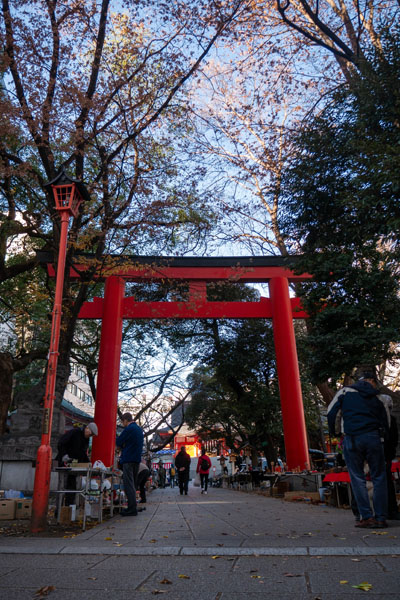
When I walked into Hanazono Shrine, my first reaction was: the worship hall is so red!
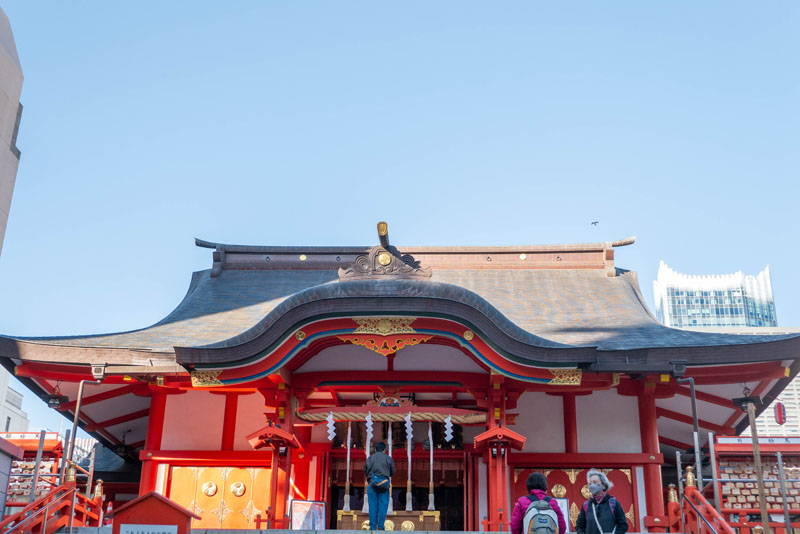
Although most of the shrines I have visited are in Kyoto, even Yasaka Shrine, which already left a strong impression on me with its vivid colors, did not give me the same visual impact as Hanazono Shrine. I had just entered from the side gate, where the ground was covered with golden ginkgo leaves. My eyes were still in a soft autumn mood. Then I looked up and saw this bright red shrine building with extremely strong color saturation. It honestly stunned me.
The weather that morning was clear, and the blue sky looked almost freshly washed. There were hardly any clouds. It may also be because the shrine is located in the middle of Shinjuku, surrounded by gray-white buildings and glass walls. Against such a cool-toned background, the red shrine building looked like a bold stroke of color suddenly appearing in a grayscale photo. That red, made even stronger by its surroundings, left a very deep impression on me.
This kind of red also looks especially beautiful during the cherry blossom season in spring. When a richly colored building meets seasonal flowers, the visual effect can be amazing. I have seen many stylish cherry blossom photos online. On Google Maps, there are also many photos of the shrine grounds lit up by soft pink cherry blossoms in full bloom. Together with the bright red shrine building and a clear blue sky, the photos are really attractive. If I have the chance next time, I would like to visit the market again in spring and take photos of the shrine and market under the cherry blossoms.
Besides the open-air antique market held every Sunday morning, Hanazono Shrine also has two important traditional festivals every year: the Reitaisai Festival in late spring and the Tori-no-Ichi Fair in autumn. Both events are quite large. They use not only the entire shrine grounds but also the surrounding streets. They may also affect the market schedule, so if you want to visit the market, I recommend checking the dates in advance.
The Tori-no-Ichi Fair, also called the Otori Festival, is held every November and is one event I really want to attend. The date is based on the “day of the rooster” in the traditional zodiac calendar, so it changes every year. Depending on the year, there may be two or three festival days. The main attraction is the sale of beautiful decorative kumade rakes, which are believed to “rake in good fortune.” They are said to bring wealth, good luck, and business success when placed in a shop or home. Many shop owners and company workers visit every year to buy these lucky items.
Most importantly, the Tori-no-Ichi Fair continues into the evening. After the lanterns are lit at night, the atmosphere becomes completely different from daytime. You can visit other places during the day and come here in the evening. It feels like a perfect way to make full use of the day.
Another important event is the Reitaisai Festival, held in late May. It is usually close to May 28, but the exact date should still be checked on the official announcement. The main highlight of the festival is the mikoshi parade. The portable shrine is carried through the city streets, and there are also food stalls and market stalls inside and around the shrine. It is an important event in the Shinjuku area.
However, this festival is more local in nature, so there is relatively less information available. I suggest joining with a flexible mindset, so you will not feel too disappointed if your schedule does not work out. If you visit Tokyo in May and enjoy this kind of Japanese festival, there is also the Sanja Matsuri in Asakusa about one to two weeks earlier in mid-May. It is a much larger festival with more available information, so you can also consider planning both together.

If you visit Hanazono Shrine in summer, I recommend stopping by Hanazono Manju (花園万頭, a traditional Japanese sweets shop) across the street. I had originally planned to visit it during this trip, but I was in a hurry to go to Oedo Antique Market and completely forgot. I was honestly so frustrated when I realized it later.
However, I later found out that the kuzumanju I wanted to buy is a popular summer-only item. Since I visited in December, it was not available at that time. Instead, they had their signature tawara-shaped joyo manju. The outer layer is made with Yamato yam from Sakura and shinko rice flour, while the filling uses red beans from Tokachi, Hokkaido, and wasanbon sugar. It is a very famous sweet.
Although I could not buy the kuzumanju, the tawara-shaped joyo manju was also related to what I had learned in class. I really regret missing it. Next time I visit, I definitely want to try it.
Tokyo Hanazono Shrine Open-Air Market
- Date: Every Sunday
- Time: 6:30 a.m. to sunset
Some vendors may start packing up around 3:00 p.m. - Location: 5-17-3 Shinjuku, Shinjuku-ku, Tokyo, Japan
Near Shinjuku-sanchome Subway Station - Website:shinjuku.or.jp/shop/33
- The official website seems to have a security certificate issue. At the moment, it cannot be opened with Chrome, so I have included the most complete basic information I could find for now. I will update this section after the official website works normally again.
- X / Twitter:x.com/hanazonoantique
- Notes: The market may be canceled in case of rain or special events, such as Tori-no-Ichi in November.
Different Stall Styles: Small in Scale but Full of Charm
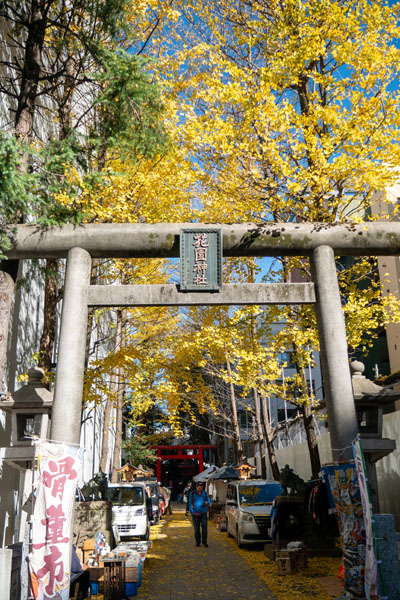
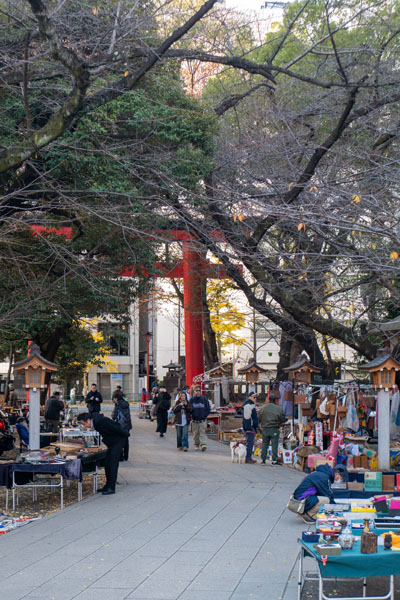
The open-air market starts from the gray torii side gate near the Karajuro Monument, which is a Tangible Cultural Property of Shinjuku City. It then extends toward the large torii gate at the main entrance and the worship hall, forming an L-shaped route.
Although I often complain that Google Maps always leads me into shrines through side gates, this time I have to praise it. This side path happened to be a shrine approach lined with two rows of ginkgo trees.
I arrived at around 8:00 a.m. that day. The sun was not high yet, and the light was as soft as the evening glow. It fell gently on the golden leaves covering the ground. The ginkgo trees and morning light created a soft and beautiful atmosphere that was hard to describe.
Together with the antique stalls around the path, the whole scene felt like a nostalgic little stage with a carefully prepared background. The red torii gate stood quietly in front of it.
Most of the vendors on the gray torii gate side drove their vehicles directly onto the shrine approach. They opened the back of their cars, spread cloths on the ground, and started selling their items right there.
The products in this area were mostly old Japanese items from the Showa era or earlier, along with everyday folk goods. Each item looked as if it had been hidden away in someone’s storage room for many years before finally appearing again. It gave the area a strong treasure-hunting feeling.
The style of this section reminded me of Oedo Antique Market. The scale was smaller, but the atmosphere felt more relaxed and closer to everyday street life.
Although there were not many items here, the quality was much better than expected for the price. I found a kanzashi hairpin that I really liked, but I hesitated. After all, a hairpin like this cannot be handled too roughly. It was also an older piece, so it would definitely need to be treated with care.
Later, when I went to Oedo Antique Market, I saw similar hairpins. However, the quality was not as good as the one here, and the price was about the same. At that moment, I almost wanted to go back to Hanazono Shrine and buy it.
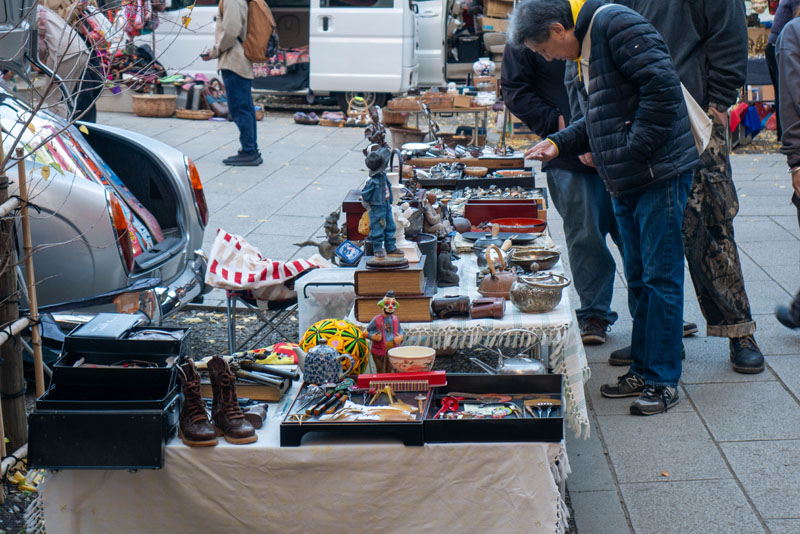
In contrast, the main approach from the large torii gate at the front entrance to the worship hall had a slightly different type of stall. Most of the items sold there were everyday goods from the Showa era to the early Heisei period.
Personally, I prefer older vessels and daily-use antiques, so although I found the items in this area interesting, they were not exactly what I was looking for. However, if you enjoy looking for retro items from the Showa era, you may be able to find many good pieces here.
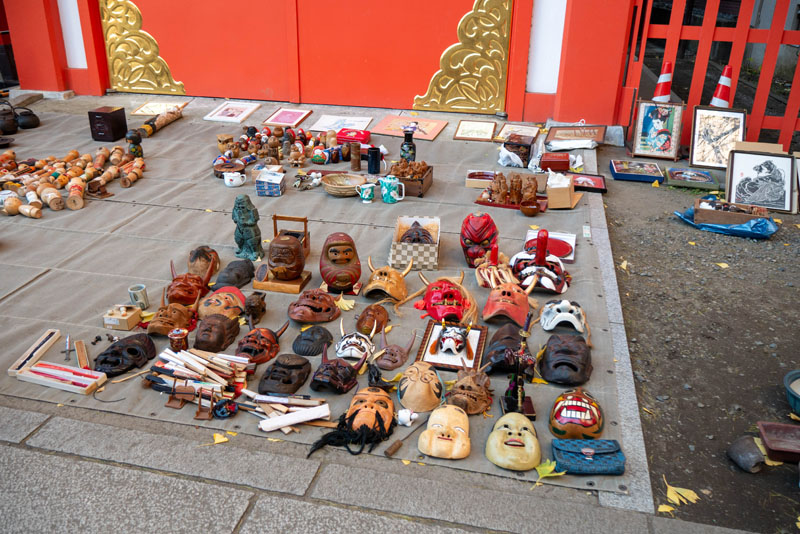
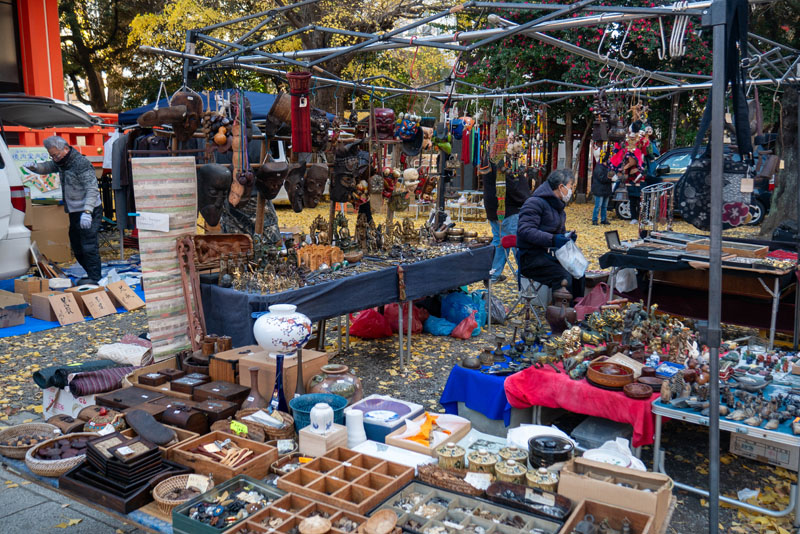
Among all the stalls, one had a very distinctive style. In front of this small stall, there were many wood carvings, metal charms, and bronze items. Several animal deity figures, traditional toys, and old toys were also displayed among them.
The items at this stall had a mixed South Asian or Southeast Asian style. It was rare for me to see this kind of stall at a market. Among the secondhand markets I have visited before, I rarely remember seeing anything with this kind of atmosphere.
Several rows of small cat and owl figures were quietly lined up together. Some were made of wood, while others were bronze statues. The wooden cat with its head tilted was especially cute. Later, I saw a similar wooden carving at Mikii Inari Shrine in Akasaka, which felt like a nice coincidence.
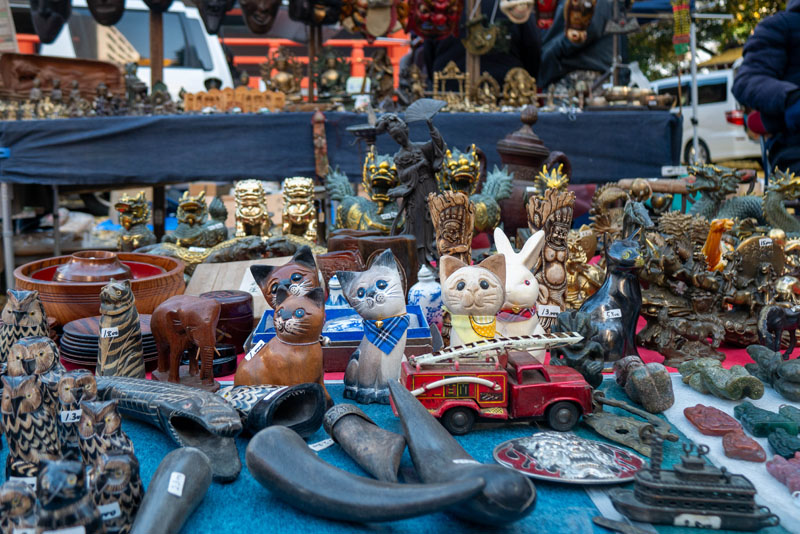
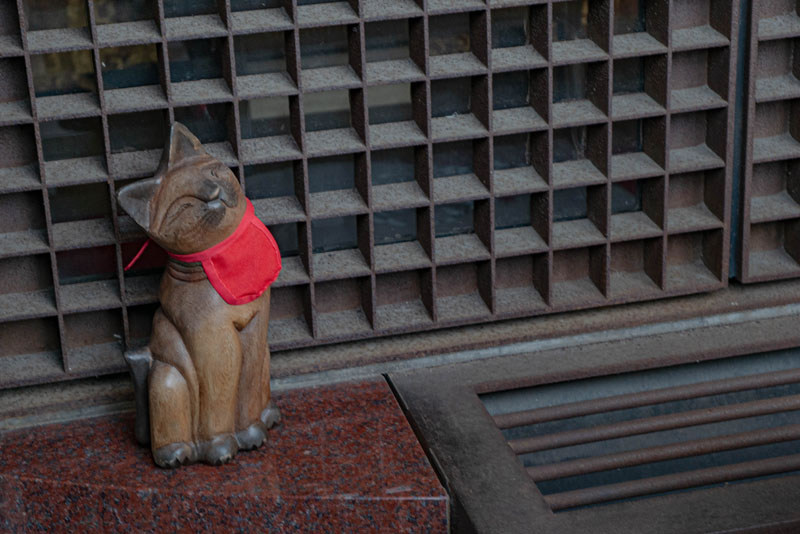
In the end, I bought an enamel owl brooch from this stall. Both the colors and the expression were very cute. I especially liked its sideways glance. For some reason, that little look really caught my heart. Luckily, the price was not expensive, so I decided to take it home right away.

Overall, the open-air market felt a little like a smaller version of Setagaya Boroichi. There was a bit of everything, and anything could appear. This was especially true along the main shrine approach. The items there were hard to classify, but that also made the treasure-hunting experience feel fresher and more exciting.
What surprised me even more was that many of the visitors were foreign tourists. They were not only from Asia. There were also quite a lot of Western visitors. Several older stall owners could introduce their items in simple English. Some younger vendors spoke fluent English right away. Outside of hotels, this was probably one of the rare times I had seen such a high level of English use among Japanese people at a local event.
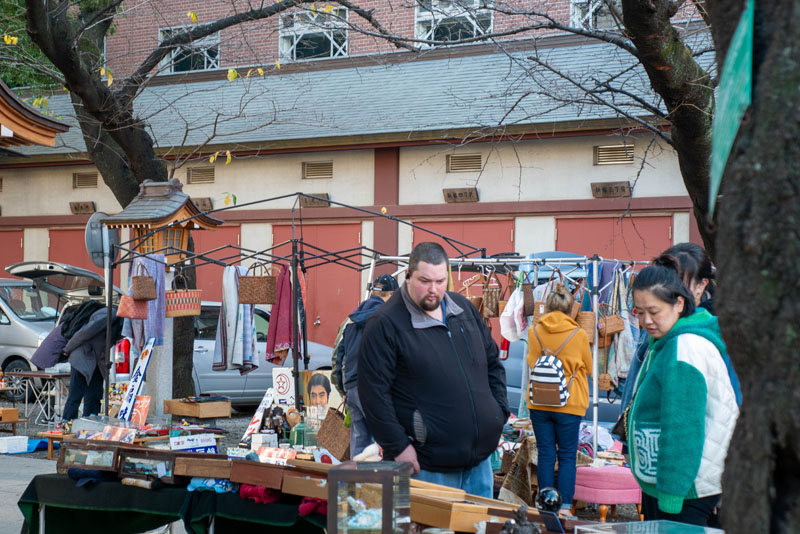
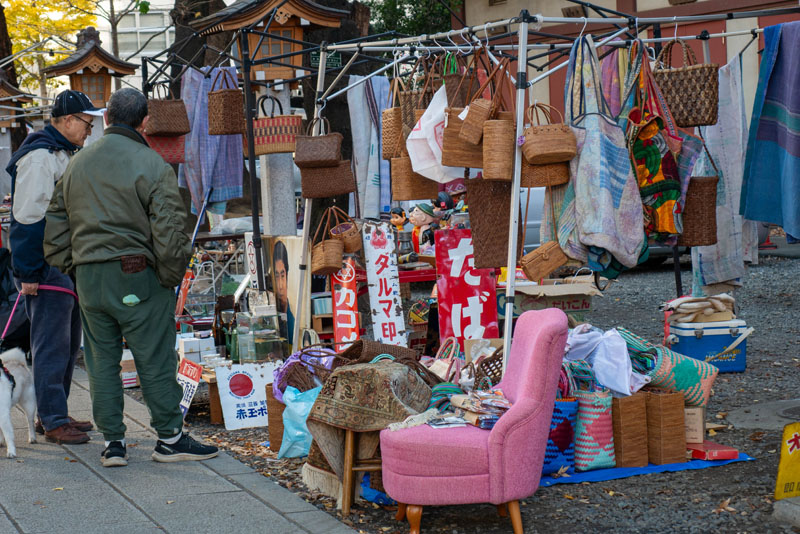
The scene that left the deepest impression on me happened in the side gate area. I saw a woven rattan handbag there, and its color immediately caught my eye. The overall shape also looked like the Rikyu bag style that I like. However, this kind of basket takes up a lot of space. While I was thinking about whether to buy it, the stall owner somehow started talking to me.
To my surprise, he was a Japanese man who had just returned from a trip to Taiwan. Using a translation app, he chatted with me about the features of the rattan basket I liked. He also laughed and said that the Taiwanese hand baskets on the shelf were things he had brought back from his trip. He thought they were very useful.
He was a very warm and friendly older vendor, and the quality of his rattan baskets was also quite good. However, they would have taken up too much space in my suitcase. In the end, I could only give up with regret.
Conclusion: Owls and Small Joys Under the Ginkgo Trees
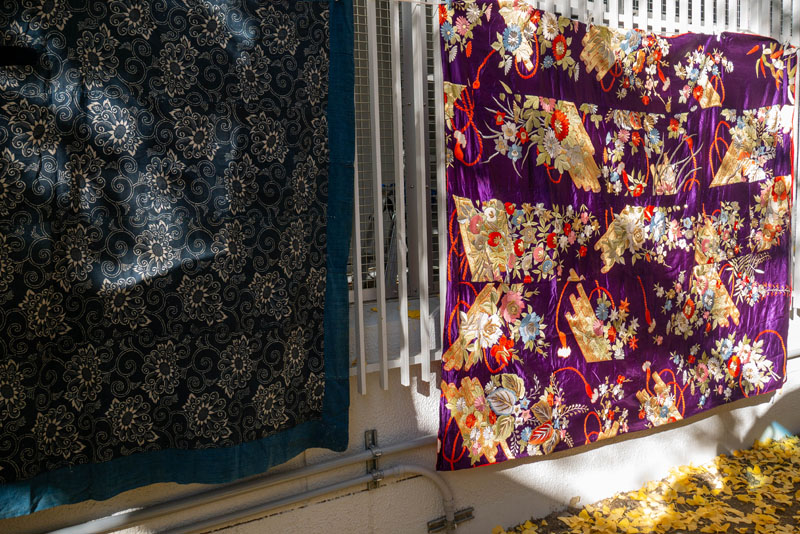
The open-air market itself is not very large, but the items sold at the stalls all had a nice sense of quality. There were quite a lot of foreign visitors, and many stall owners could communicate in simple English. Some older vendors were also very friendly and willing to chat for a few words.
Maybe it was because I arrived early, or maybe this kind of small market is simply less crowded. Either way, walking around that morning felt especially comfortable. I could slowly look at each stall, and when I saw something I liked, I did not need to squeeze through a crowd to see it. This slower pace made the whole experience feel very relaxing.
Another good thing is that the market starts very early. You can visit in the morning without taking too much time away from other attractions. If you are already planning to spend time around Shinjuku, you can come here one or two hours earlier for a walk. By the time it gets close to noon, most shops nearby will be open. Whether you want to shop, find something to eat, or move on to your next stop, it is all very convenient.
The happiest part of this visit was finding that cute owl brooch under the ginkgo leaves. In Japanese, the word for owl sounds close to the word for “good fortune,” so being able to buy a little “fortune” felt like a lucky moment in my trip. If I have the chance, I would like to visit again during Tori-no-Ichi in November and see the ginkgo leaves at the same time. I would also like to come between June and August to buy the summer-only kuzumanju from Hanazono Manju, then stop by the market again. If I can meet the friendly older vendor who had visited Taiwan again, maybe this time I can finally bring home the rattan basket I liked. The one I usually use at home has been broken by me, sadly.
This is what markets are like. Sometimes you do not go with a clear purpose, but they still bring unexpected surprises and warmth. Even a simple walk along the shrine approach, a short chat with a stall owner, or a small item brought home can become a memorable part of the trip. This is also what makes small markets so charming. There is less noise, and the distance between people feels a little closer.
At moments like this, I really regret not studying Japanese properly. Many people say that translation apps can replace cross-language communication. But the more I experience this kind of deeper human contact, the more I feel that conversations without a machine in between still have a warmth that translation apps cannot replace. Of course, at this stage, I still have to rely on translation apps for help.
*Unless otherwise noted, all photos in this article were taken by the author (yanshoto.com) during personal travels and are fully copyrighted. Please do not reproduce or use them for commercial purposes without prior permission. Thank you for your understanding and respect.
Tokyo Market Review
- Wandering the Oedo Antique Market: An Afternoon in Tokyo Where East Meets West in Timeless Nostalgia
- Zoshigaya Handmade Market & Otori Shrine Visit Part 1: A Winter Afternoon of Temple Markets, Dango Tasting, and a Visit to Yumeji’s Grave
- Zoshigaya Handmade Market & Otori Shrine Visit Part 2: Year-End Prayers Among Ceramic Plates and Winter Sunlight at a Local Shinto Shrine
