
- Discover Kyoto Through Fragrance: 10 Unique Incense Shops to Visit Part 2 | Kiyomizu-dera and Yasaka Shrine Area - 2026-10-08
- Solo Stay at Juyoh Hotel: A Private Japanese-Style Room Near Minami-Senju, with Easy Bus and Subway Access Around Tokyo - 2026-09-28
- Visiting Oisesan Geku Main Store in Ise: More Than Purifying Salt Spray, with Cleansing Fragrances, Goods, and Limited Gachapon - 2026-09-14
Now it is time to continue to Part 2 of this complete Kyoto incense shop guide. In this article, I will introduce incense shops located near Kiyomizu-dera and Yasaka Shrine.
One shop worth mentioning in particular is Toyoda Aizandō (豊田愛山堂). Compared to the other shops in this article, it is located slightly farther away, right next to Yasaka Shrine. However, most visitors who plan to visit Kiyomizu-dera also include Yasaka Shrine in their travel route. The shopping street where Toyoda Aizandō is located is especially popular and is a place many visitors naturally pass through.
Because of this, all the incense shops introduced in this article can be considered part of the same general area. When organizing this guide, I grouped the shops based on minimizing travel distance, which is why they are introduced together in this section.
In general, incense shops in this area are quite concentrated. It is possible to visit up to five incense shops in a single day. If your goal is to visit as many incense shops as possible within a limited time, I highly recommend the Kiyomizu-dera area. There are four incense shops within close distance, making this one of the most efficient areas to explore.

The shops in this guide are introduced in order, following the route uphill toward Kiyomizu-dera.
Toyoda Aizandō is located along the shopping street, so you may choose to visit it either before heading up to Kiyomizu-dera or after coming back down. The timing can be adjusted based on your own travel schedule.

Niimi Sann 二井三

I did not purchase anything from this shop. Perhaps the atmosphere simply did not resonate with me.
The incense sticks in the store did not match what I was looking for. As I mentioned earlier, my focus was on incense made primarily from natural aromatic wood. However, most of the incense sticks here contained added fragrance ingredients. There is nothing wrong with that, but it was not my priority for this trip. Even the incense that appeared to be more wood-based did not leave a strong impression when I first smelled them.
The shop also offered incense holders and incense burners, and some of them were quite interesting. The more expensive ones were beyond my budget, while the more affordable ones did not strongly appeal to me. There were a few creative designs, such as incense holders shaped like coffee cups and clam shells. Although they were unique, the prices felt slightly high. I decided to wait and explore other shops first. Later, I noticed similar designs in other incense shops, and the prices were quite similar.
If you do not have time to visit many incense shops like I did, and you find something you like here, it would still be a good place to make a purchase.
One of the most distinctive displays in the shop was located at the back. It featured an incense collection inspired by The Tale of Genji (源氏物語), presented in a full display case. The presentation was elegant and visually impressive.
Niimi Sann 二井三
- Photo source: Google. I originally took a photo with my phone, but unfortunately the file was not saved.
- Opening Hours: 10:00 AM–6:00 PM
- Closed: Open year-round
- Address: 351-4 Masuyacho, Kodaiji Minamimon-dori Shimogawara Higashi-iru, Higashiyama-ku, Kyoto 605-0826, Japan
- Phone: +81-75-551-2265
- Official Website: Gion Niimi Official Website (English)
Koju Ninenzaka Store 香十 二寧坂店

Koju was founded in Tensho 1, which corresponds to 1574. It is another long-established incense shop in Kyoto.
This shop was an unexpected discovery. It was not introduced in the book I used as a reference. After leaving Niimi Sann, we were on our way to Shoyeido when my classmate noticed the shop. At first, my classmate was not very interested in incense. However, as we continued visiting shops, she gradually became more curious and eventually started buying incense as well. In fact, she became even more serious than I was about searching for incense shops.
One of the most distinctive items in this store was their incense holders. I did not see the same designs in any other shop afterward.
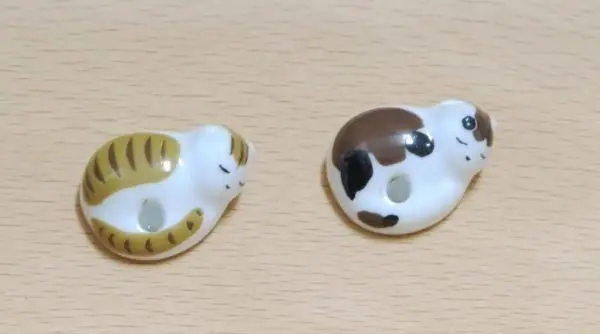
The most memorable ones were shaped like sleeping cats. Each one cost a little over 200 yen, and there were three different designs. I chose the tabby cat and the calico cat. I picked these because they perfectly captured the adorable expression of a cat sleeping peacefully. The facial details were especially charming. The price was also very affordable, less than 300 yen each.
Originally, I planned to give them as gifts. However, they were so cute that I ended up keeping them for myself.

Another design that caught my attention was shaped like a traditional temari ball. This one was especially unique. When closed, it appears as a decorative sphere, but it can also be opened and used to hold incense sticks.
The price was also very reasonable at 1,200 yen including tax, and it was available in four different colors.

When opened, the sphere can also hold cone-shaped incense. This makes the piece suitable for different types of incense, which gives it excellent versatility and value.
I decided to buy it immediately. It was available in three colors, and both my classmate and I agreed that the red one was the most beautiful.

Their scented sachets were also quite unique, and surprisingly expensive. The contents and the outer pouch were sold separately. At first, I naively thought it was a customizable option where you could freely mix and match.
In the end, I only purchased the scented filling itself. I decided to sew my own outer pouch after returning home. Fortunately, the incense filling was already packaged inside a small inner mesh bag, so it was ready to use.

Many other incense shops use luxurious fabrics such as chirimen crepe or kinran brocade for their scented sachets. This is because they place the incense powder directly inside the pouch. Fabrics with lower density would allow the fine incense powder to escape through the weave.
Since the incense filling I purchased was already sealed inside its own inner bag, I could simply use some kimono fabric from my collection and sew my own outer pouch.
At the front of the shop, most of the incense sticks on display were popular fragrance blends. Since these were not my focus, I moved toward the back of the store after selecting my incense holders. The back area clearly featured products related to Kōdō and incense made from pure aromatic wood.
While browsing, I noticed a product called Kyara Seigen (伽羅 静玄), which appeared to be very special. The price was quite astonishing, so I could not help but examine it more closely. Perhaps not many tourists show interest in this type of incense, because a staff member soon approached me and began explaining it in Japanese.
To be honest, I understood almost nothing. Even with gestures, I could only grasp a small part of the explanation. The staff member may have sensed my confusion, so she kindly lit a sample for me to smell.
The fragrance was completely different from both sandalwood and agarwood. It belonged to an entirely different category. I could not immediately say whether I liked it or not, but after seeing how carefully the staff introduced it, I decided to purchase it.
Since it was extremely expensive, I chose the smallest box. I plan to save it for special occasions.

The staff were very warm and proactive. My classmate and I did not specifically ask to test any incense, but the staff kindly offered to light samples so we could experience the fragrance.
I was very grateful for their initiative. Without their help, it would have been difficult to ask for a demonstration due to the language barrier.
Koju Ninenzaka Store 香十 二寧坂店
- Opening Hours: 11:00 AM–6:00 PM
- Closed: No regular closing day is listed. Please check the official website for temporary closures.
- Cards: AcceptedAddress: 349-8 Masuyacho, Higashiyama-ku, Kyoto 605-0826, Japan
- Phone: +81-75-551-0285
- Official Website: Koju Official English Store Informatio
Shoyeido Sanneizaka Store 松榮堂 産寧坂店

Shoyeido was founded in Hoei 2, which corresponds to 1705. In Kyoto, the company operates four stores in total. Besides the main store, there is one near Kiyomizu-dera, one near Kyoto Station, and one in Arashiyama.
Originally, I wanted to visit the main store as a kind of pilgrimage. However, since I was already near Kiyomizu-dera, I decided to stop by the Sanneizaka store instead.
The atmosphere of the Sanneizaka store felt similar to Koju, which I had just visited, but with an even stronger Kyoto machiya character. The interior design was calm and refined, giving a sense of stability, much like the feeling incense itself can create. Even though we had a language barrier, the staff were still very welcoming and took time to explain the products.
The product range here was especially comprehensive. In particular, items related to Kōdō were more complete than in the previous shops I had visited. On the other hand, the selection of incense sticks was not as large as I had expected.
They also offered several types of kneaded incense and aromatic wood used for room fragrance, and most of them could be tested. Although the scent when smelling a sample may not be exactly the same as the scent during actual use, testing still helps you decide whether the fragrance suits you.
One distinctive feature was their kneaded incense assortment. It included six different varieties: Shōbai, Un’i, Shōtō, Saiun, Matsu no Rei, and Karakoromo. In other incense shops, plum fragrance is more commonly seen in kneaded incense, although different grades are still available. However, it is rare to see such a wide variety displayed so clearly as at Shoyeido.

They also offered aromatic wood suitable for room fragrance use. I selected 10 grams of Old Mountain sandalwood, known as Rōzan Byakudan (老山白檀). The quantity felt quite generous, and it was the most affordable option in this series, so I decided to purchase it and give it a try.

For the incense sticks, I hesitated between buying a large box or a small one. I asked my classmate to help me ask the staff how many sticks were included in a large box. The staff kindly checked for us. It might not be a common question. The answer was about 450 sticks.
If you burn one stick per day, it would last more than a year. That means it could easily last until my next trip to Japan for classes. Since the quantity was generous, I started using it right away during my stay. As an exam candidate, I needed something to help calm my mind.
When choosing incense sticks, you can clearly notice differences in fragrance. Incense is similar to tea. More expensive does not always mean better. What matters most is your personal preference. Next to the one I chose, called Kasumi Bara (かすみバラ詰), there were slightly more expensive options. However, I did not like their scent as much. In the end, I stayed with the one that suited me best.

I was also able to purchase hibashi (fire chopsticks) used in Kōdō. I had not seen them in the previous shops, so I was starting to worry that I might not find any.
Although there was a sign indicating the item, none were displayed on the shelf. With the help of gestures and my classmate’s assistance, the staff brought one out from the storage box. Perhaps this item is not commonly purchased in tourist areas.
The price was lower than I expected, around 1,600 yen. Later, I also saw similar ones at Yamadamatsu Incense-Wood Co., Ltd., and they were even more affordable. It is worth comparing prices and choosing the one you prefer.

I also saw the zukō (塗香) introduced in the book. The incense powder itself was not expensive, but the black sandalwood container cost more than 3,000 yen, which made it difficult for me to justify the purchase.
Later, I saw the same container at the main store, Yamadamatsu Incense-Wood Co., Ltd., and Toyoda Aizandō. In addition to black sandalwood, there were two other material options available, with prices starting at around 2,000 yen.
However, since I had already purchased a large amount of incense products, I decided to restrain myself and not buy it. Even so, I found it very interesting and was quite tempted.
Shoyeido Sanneizaka Store (松栄堂 産寧坂店)
- Opening Hours: 10:00 AM–6:00 PM
- Closed: Open year-round
- Credit Cards: Accepted
- Tax-Free: Not available at the Sanneizaka Store. For tax-free shopping, the Kyoto Main Store is recommended.
- Address: Seiryuen, 3-334 Kiyomizu, Higashiyama-ku, Kyoto 605-0862, Japan
- Phone: +81-75-532-5590
- Official Website: Shoyeido Official English Store Information
Akebono-tei Iwai あけぼの亭 井和井|This Location Is Now Closed

This shop felt more like a Japanese lifestyle and souvenir store. Incense sticks, incense containers, and incense plates were only part of their overall product range. The prices were quite affordable, but their incense selection focused more on blended fragrances rather than the natural aromatic wood types I was looking for. The incense containers and plates were also fairly common designs, similar to ones I had already seen at Niimi Sann.
What I found more interesting here were the handles designed for furoshiki wrapping cloths. They offered both traditional handle-style grips and ring-shaped handles. In Kyoto, furoshiki specialty shops more commonly carry the handle-style versions, while souvenir shops in Shijo Kawaramachi tend to sell the ring-shaped type. This shop offered both options, and the prices were reasonable. I slightly regret not purchasing one here.
However, I would not recommend making a special trip just for this shop. If you happen to pass by, it is worth stopping in. The location itself is quite unique, as the store is situated midway along a staircase on a sloped street.

I had to climb the stairs twice just to find this shop. It was raining that day, and I was wearing wooden geta sandals, which made it even more nerve-wracking. The slope was so steep that I genuinely felt like I might slip and roll all the way down.
I kept thinking that if that really happened, I would not be able to take my final exam at all. Instead, I might end up spending several days in a Japanese hospital and writing an unexpected article about the Japanese healthcare experience.
Akebono-tei Iwai (あけぼの亭 井和井)
- Address: 2-222 Kiyomizu, Higashiyama-ku, Kyoto 605-0862, Japan
- Former Operator: Iwai Co., Ltd. (株式会社井和井)
- Products: Traditional Kyoto crafts, Japanese accessories, incense, and souvenirs
- Current Status: Akebono-tei Iwai is no longer listed among Iwai’s current stores. The same building is now home to Kyoto Chano-yu Akebonotei (京都 茶の湯 明保野亭), a matcha café and tea experience venue.
- Note: The opening hours shown in my original photo were from information available at the time of my visit. Current operating information no longer applies to the former Iwai store.
Toyoda Aizandō 豐田愛山堂

Toyoda Aizandō is located on the Gion shopping street directly in front of Yasaka Shrine. It works well as either the starting point or the final stop of an incense shop tour in the Kiyomizu-dera area, making it very easy to include in your itinerary. Transportation is also very convenient. Nearby bus stops include Gion-mae and Shijo Keihan-mae, and the Keihan Railway Gion-Shijo Station is also within walking distance. Among all the incense shops I visited, this one was the easiest to access.
Near Exit 8 of Gion-Shijo Station, you will also find one of Kyoto’s most popular bakeries, Shinshindo Bakery. Their signature item is the fried beef cutlet sandwich. Since I do not eat beef, I tried other options instead. The melon bread was especially memorable and delicious.
If you visit Kiyomizu-dera first, you can walk toward Yasaka Shrine afterward. Toyoda Aizandō is located along the shopping street right in front of the shrine’s main entrance. After visiting the shop, you can also stop by Tsujiri Kyoto Main Store across the street and enjoy a matcha ice cream.
Tsujiri is already well known, but many people do not realize that its original shop, Tsujiri Tea Shop, was first established in Taipei during the Japanese colonial period. It was located in what was then called Sakaemachi, at the intersection of present-day Chongqing South Road and Hengyang Road, where a Starbucks now stands. The former chairman, Mitsuhiro Miyoshi, who passed away in March 2009, was born in Taiwan. He was part of the Wansei generation and could even speak Taiwanese, including phrases such as “monkey child.”

However, this was actually the last incense shop I visited, and also the one I visited the most. I went there three times. The main reason was its convenient location, only about a five-minute walk from my hotel.
On my final visit, I first stopped by the Sagawa Express service center to pick up my package, and then walked over to the shop afterward. I would also like to mention the Sagawa Express Gion branch (〒605-0074 Kyoto, Higashiyama Ward, Gionmachi Minamigawa 570-189). It blended so naturally into the surrounding streets that I did not even realize it was a delivery service center at first. I only noticed it because a delivery truck happened to arrive at that moment.

One of the most notable features of Toyoda Aizandō is that it serves as the official incense supplier to Chion-in Temple. Because of this, many of the notices and events displayed in the shop are related to temple activities. They all looked very interesting, but unfortunately, I was near the end of my trip and did not have enough time to participate.
The interior of the shop felt more formal and solemn compared to Yamadamatsu Incense-Wood Co., Ltd. and the Shoyeido Sanneizaka Store. There was also less interaction with the staff, making it the most reserved atmosphere among all the incense shops I visited. It almost felt like being inside a temple rather than a retail store.
By this point in my journey, I had already purchased many incense holders and incense plates, and I had promised myself not to buy any more. However, Toyoda Aizandō offered unique incense holders made of tin, with designs such as cherry blossoms, snowflakes, maple leaves, and crabs. I had not seen these designs in other shops. The price was also very reasonable, around 200 yen each.
The snowflake design stood out to me the most, so I chose that one. I also picked the cherry blossom design. Since I did not get to see cherry blossoms during this trip, at least I could bring a small cherry blossom back home with me.

When my classmate saw the tin incense holder I purchased, she was amazed by it. She told me that Shoyeido also offered similar designs, but theirs were made of pure silver. She had really liked them at the time, but the price was too high for her to justify buying one.
So when she saw this similar design made of tin, she immediately decided to purchase one as well. She chose the crab design. Looking back, I think I should have bought the crab too. It was very cute, and I had not seen that design in any other incense shop.

The shop keeps one box open in the display area so customers can smell the incense. However, the products for sale are sealed with shrink wrap. When I was packing my luggage to return home, I realized how convenient this packaging was. It prevents the box from opening during transport and protects the incense sticks from being damaged.
For incense purchased from other shops, I even used masking tape to secure the edges of the boxes, just in case they might open during travel. However, if you plan to open and use the incense while still in Japan, whether this type of packaging is convenient or not depends on personal preference.
As for incense sticks, I had already decided not to buy any more. I had purchased two large boxes at Yamadamatsu Incense-Wood Co., Ltd., and I had also bought some from Shoyeido and Kyukyodo. However, while testing samples at the shop, I was drawn to the fragrance of Seijukō.
I really wanted to ask the staff to light it so I could smell the scent after burning. Unfortunately, because my Japanese is limited, I gave up on the idea. Instead of buying a large box, I chose a smaller one to save some money.

The shop keeps one box open in the display area so customers can smell the incense. However, the products for sale are sealed with shrink wrap. When I was packing my luggage to return home, I realized how convenient this packaging was. It prevents the box from opening during transport and protects the incense sticks from being damaged.
For incense purchased from other shops, I even used masking tape to secure the edges of the boxes, just in case they might open during travel. However, if you plan to open and use the incense while still in Japan, whether this type of packaging is convenient or not depends on personal preference.
As for incense sticks, I had already decided not to buy any more. I had purchased two large boxes at Yamadamatsu Incense-Wood Co., Ltd., and I had also bought some from Shoyeido and Kyukyodo. However, while testing samples at the shop, I was drawn to the fragrance of Seijukō.
I really wanted to ask the staff to light it so I could smell the scent after burning. Unfortunately, because my Japanese is limited, I gave up on the idea. Instead of buying a large box, I chose a smaller one to save some money.

They also sell scented sachets. However, in my personal opinion, the level of craftsmanship did not feel as refined as the ones from Yamadamatsu Incense-Wood Co., Ltd. or Ishiguro Incense Shop.This was especially noticeable with the flower-shaped sachets. After seeing the designs at Yamadamatsu, it became difficult for me to feel equally impressed by similar products in other shops.
Shop Information
- Opening Hours: 10:00 AM–6:00 PM
- Closed: Wednesdays Address: 277 Gionmachi Kitagawa, Higashiyama-ku, Kyoto 605-0073, Japan
- Phone: +81-75-551-2221
- Official Website:Toyoda Aizandō Official Website
*Unless otherwise noted, all photos in this article were taken by the author (yanshoto.com) during personal travels and are fully copyrighted. Please do not reproduce or use them for commercial purposes without prior permission. Thank you for your understanding and respect.
Related Incense Articles
- Discover Kyoto Through Fragrance: 10 Unique Incense Shops to Visit Part 2 (English version coming soon.)
- Discover Kyoto Through Fragrance: 10 Unique Incense Shops to Visit Part 3 (English version coming soon.)
- Beginner’s Kōdō Experience in Taiwan: Understanding Agarwood Origins and How to Use Incense Tools Properly (This link leads to a page written in Chinese only.)
